
Contents
Overview
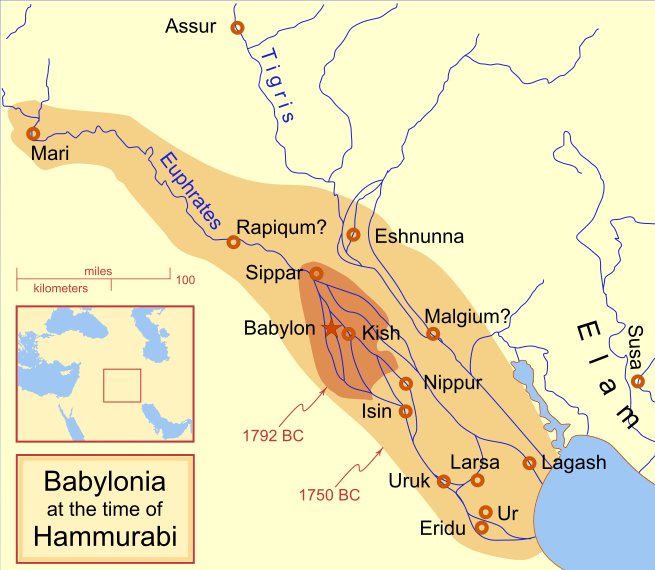
The Babylonians were an ancient Mesopotamian civilization centered around the city of Babylon, flourishing primarily between the 19th and 6th centuries BC. They were a Semitic people, speaking Akkadian, who inherited and significantly developed the rich cultural and scientific traditions of Sumer and Akkad. Renowned for their sophisticated legal systems, they also made groundbreaking advancements in mathematics, astronomy, and literature. Their influence extended across the ancient Near East, shaping subsequent empires and laying foundations for fields like algebra and celestial observation. Despite periods of subjugation and shifting political landscapes, the Babylonian identity persisted, leaving an indelible mark on human history.
🎵 Origins & History
The Babylonian civilization emerged from the fertile crescent of Mesopotamia, a region that had already witnessed the rise and fall of earlier powers like the Sumerians and the Akkadian Empire. Following periods of foreign domination by the Hittites and Kassites, a resurgence occurred with the Neo-Babylonian Empire, a period marked by monumental architecture, astronomical achievements, and the famous Babylonian Exile of the Jews. This empire ultimately fell to Cyrus the Great of Persia, marking the end of independent Babylonian rule.
⚙️ How It Works
Babylonian society was highly structured, with a complex administrative system that managed agriculture, trade, and taxation. Their economy was largely agrarian, relying on the irrigation systems developed from earlier Mesopotamian cultures to cultivate crops like barley and dates. Trade was also vital, with Babylon serving as a hub connecting regions from the Persian Gulf to the Mediterranean. Their religious system was polytheistic, with a pantheon of gods and goddesses. Babylonian culture was deeply intertwined with religious practices, including elaborate temple rituals and divination.
📊 Key Facts & Numbers
The Babylonians achieved remarkable feats in mathematics, developing a sexagesimal (base-60) number system that still influences our measurement of time (60 seconds in a minute, 60 minutes in an hour) and angles (360 degrees in a circle). They possessed advanced knowledge of arithmetic, algebra, and geometry, capable of solving linear and quadratic equations and calculating areas and volumes. In astronomy, they meticulously observed and recorded celestial phenomena, developing sophisticated calendars and predicting eclipses with impressive accuracy. Their astronomical observations were crucial for astrology, which played a significant role in Babylonian court life and decision-making. The city of Babylon itself was a marvel of urban planning, with estimates suggesting its population reached between 200,000 and 1,000,000 inhabitants at its peak, making it one of the largest cities of the ancient world.
👥 Key People & Organizations
Key figures in Babylonian history include King Hammurabi, whose legal code and empire-building defined the Old Babylonian period. Nebuchadnezzar II is the most prominent ruler of the Neo-Babylonian Empire, credited with extensive building projects in Babylon, including the legendary Hanging Gardens. Nabopolassar, his father, founded the Neo-Babylonian dynasty. In the realm of science, figures like Nabu-rimanni (known to the Greeks as Kidinnu) made significant contributions to astronomical calculations. The city of Babylon itself, as a political and cultural entity, functioned as a central organization, housing the royal court, temples, and administrative bodies. Later, figures like Nabopolassar and Nabuna'id played crucial roles in the Neo-Babylonian dynasty.
🌍 Cultural Impact & Influence
The cultural legacy of the Babylonians is profound and far-reaching. Their legal codes, particularly the Code of Hammurabi, provided a model for subsequent legal systems, emphasizing principles of justice and retribution. Babylonian mathematics, with its base-60 system, continues to influence how we measure time and geometry. Their astronomical observations and astrological practices laid the groundwork for later astronomical developments, and their detailed celestial records were invaluable to Greek and later astronomers. Babylonian literature, including epics like the Epic of Gilgamesh (though originating earlier in Sumerian, it was preserved and expanded by Babylonians), has provided enduring narratives and insights into ancient Mesopotamian thought and values. The very concept of a "city" as a center of power, culture, and commerce owes much to the model of Babylon.
⚡ Current State & Latest Developments
While the Babylonian civilization as a distinct political entity ceased to exist after the Persian conquest in 539 BC, its cultural and intellectual heritage continues to resonate. Modern Iraq, the heartland of ancient Babylonia, is a site of ongoing archaeological research, continually unearthing new insights into their civilization. The study of Babylonian mathematics and astronomy is an active field within the history of science, with scholars constantly re-evaluating their achievements. The Neo-Babylonian Empire's astronomical records, housed in institutions like the British Museum, are still analyzed for their precision and predictive capabilities. The enduring fascination with figures like Nebuchadnezzar II and the mystique of Babylon, including the Hanging Gardens, ensure their continued presence in popular culture and academic discourse.
🤔 Controversies & Debates
One of the primary controversies surrounding the Babylonians relates to the interpretation and application of the Code of Hammurabi. While critics point to its harsh penalties and the inherent inequalities based on social class, a common feature of ancient legal systems. The extent to which Babylonian astronomy was purely observational versus predictive or astrological is also debated among scholars. Furthermore, the precise location and existence of the Hanging Gardens, one of the Seven Wonders of the Ancient World, remain a subject of scholarly dispute, with some archaeologists questioning whether they were a Babylonian invention or a later embellishment. The influence of Babylonian culture on subsequent civilizations, particularly ancient Greece, is also a topic of ongoing academic discussion, with varying degrees of direct transmission versus independent development.
🔮 Future Outlook & Predictions
The future of understanding the Babylonians lies in continued archaeological discovery and advanced analytical techniques. New excavations in Iraq and Syria may reveal further insights into their daily life, governance, and scientific practices. Computational analysis of their vast cuneiform archives, including astronomical and mathematical texts, promises to unlock deeper understanding of their cognitive processes and technological sophistication. The ongoing decipherment and translation of previously unstudied tablets could shed new light on their literature, religion, and social structures. Furthermore, comparative studies with other ancient civilizations, such as Ancient Egypt and the Indus Valley Civilization, will continue to refine our understanding of their unique contributions and their place in the broader narrative of human development.
💡 Practical Applications
The practical applications of Babylonian achievements are most evident in mathematics and astronomy. Their sexagesimal system is directly inherited in our modern systems for measuring time (seconds, minutes, hours) and angles (degrees). Babylonian mathematical techniques, including their methods for solving equations, provided foundational concepts that were later developed by mathematicians in ancient Greece and the Islamic world. Their astronomical observations and predictive models, while often intertwined with astrology, contributed significantly to the development of observational astronomy and calendrical systems. The meticulous record-keeping practices of the Babylonians also serve as a model for data collection and analysis in historical and scientific contexts. Their urban planning and architectural innovations, particularly in Babylon under [[Nebuchadnezzar II|Neb
Key Facts
- Category
- history
- Type
- topic