
Contents
Overview
The Coriolis effect has its roots in the work of Isaac Newton, who laid the foundation for our understanding of motion and forces with his laws of motion. However, it wasn't until the 19th century that Gaspard-Gustave de Coriolis formulated the mathematical expression for the Coriolis force, which is now a cornerstone of modern physics. The concept gained significant attention in the early 20th century, particularly in the field of meteorology, where it helps explain the behavior of high and low-pressure systems, such as hurricanes and tornadoes.
⚙️ How It Works
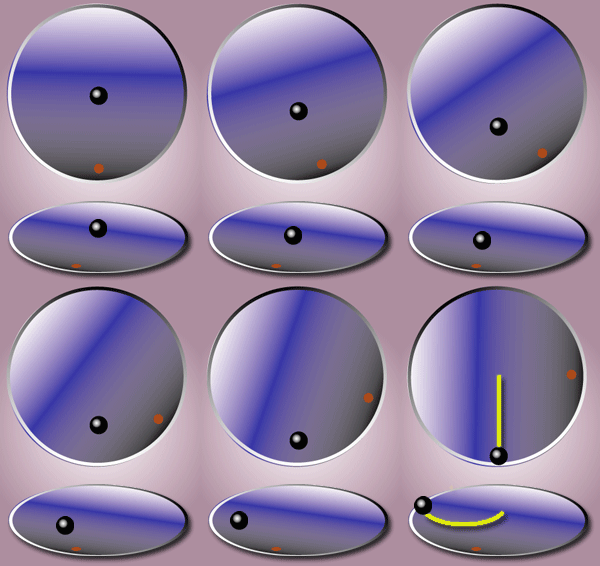
The Coriolis effect is a result of the interaction between the rotation of the Earth and the motion of objects on its surface. In the Northern Hemisphere, the Coriolis force acts to the right of the direction of motion, while in the Southern Hemisphere, it acts to the left. This deflection is responsible for the rotation of large-scale weather patterns, such as high-pressure systems and low-pressure systems. The Coriolis effect also plays a crucial role in the formation of ocean currents, such as the Gulf Stream, which helps regulate regional climates. NASA and the National Oceanic and Atmospheric Administration (NOAA) closely monitor these phenomena to better understand and predict global weather patterns.
🌍 Cultural Impact
The Coriolis effect has significant cultural and societal implications, particularly in the context of climate change. As global temperatures rise, the Coriolis effect is expected to influence the trajectory and intensity of extreme weather events, such as hurricanes and wildfires. This, in turn, can have devastating consequences for communities and ecosystems around the world. Greenpeace and other environmental organizations have highlighted the need for urgent action to mitigate the effects of climate change and protect vulnerable populations. The Coriolis effect also has practical applications in fields such as aviation and navigation, where understanding its effects is crucial for safe and efficient travel.
🔮 Legacy & Future
The legacy of the Coriolis effect extends far beyond its scientific significance, with implications for our understanding of the complex interactions between the Earth's atmosphere, oceans, and land surfaces. As we continue to face the challenges of climate change and sustainability, the Coriolis effect will remain a vital component of our efforts to predict and mitigate the effects of extreme weather events. University of Oxford and other leading research institutions are at the forefront of this research, working to develop more accurate models of the Coriolis effect and its role in shaping our planet's climate. The future of our planet depends on our ability to understand and adapt to the complex forces that shape our environment, including the Coriolis effect.
Key Facts
- Year
- 1835
- Origin
- France
- Category
- science
- Type
- concept
Frequently Asked Questions
What is the Coriolis effect?
The Coriolis effect is a pseudo force that acts on objects in motion within a rotating frame of reference, causing them to deflect from their intended path. This phenomenon is responsible for the rotation of large-scale weather patterns and ocean currents. NASA and the National Oceanic and Atmospheric Administration (NOAA) closely monitor these phenomena to better understand and predict global weather patterns.
Who discovered the Coriolis effect?
The Coriolis effect was first described by French scientist Gaspard-Gustave de Coriolis in 1835. However, the concept of the Coriolis effect is rooted in the work of Isaac Newton, who laid the foundation for our understanding of motion and forces with his laws of motion.
What are the implications of the Coriolis effect for climate change?
The Coriolis effect plays a crucial role in shaping global weather patterns and ocean currents, which in turn can have significant implications for climate change. As global temperatures rise, the Coriolis effect is expected to influence the trajectory and intensity of extreme weather events, such as hurricanes and wildfires. Greenpeace and other environmental organizations have highlighted the need for urgent action to mitigate the effects of climate change and protect vulnerable populations.
How does the Coriolis effect affect aviation and navigation?
The Coriolis effect has significant implications for aviation and navigation, as it can affect the trajectory of aircraft and ships. Understanding the Coriolis effect is crucial for safe and efficient travel, particularly in the context of long-distance flights and ocean voyages. Boeing and other leading aviation companies have developed sophisticated navigation systems that take into account the Coriolis effect and other factors to ensure safe and efficient travel.
What are the cultural and societal implications of the Coriolis effect?
The Coriolis effect has significant cultural and societal implications, particularly in the context of climate change. As global temperatures rise, the Coriolis effect is expected to influence the trajectory and intensity of extreme weather events, which can have devastating consequences for communities and ecosystems around the world. University of Oxford and other leading research institutions are at the forefront of this research, working to develop more accurate models of the Coriolis effect and its role in shaping our planet's climate.