
Contents
Overview
The conceptual roots of the data warehouse stretch back to the 1960s with the development of data management systems. Bill Inmon is often hailed as the 'father of data warehousing.' Early precursors to data warehouses included data marts and executive information systems (EIS), which provided limited analytical capabilities. The advent of relational database management systems (RDBMS) and the increasing complexity of business operations in the late 20th century created a pressing need for integrated data analysis, paving the way for the widespread adoption of data warehouse architectures by companies like IBM and Oracle. The foundational principles laid out by Inmon and later refined by figures like Larry Ellison with his vision for online analytical processing (OLAP) set the stage for the modern data warehouse.
⚙️ How It Works
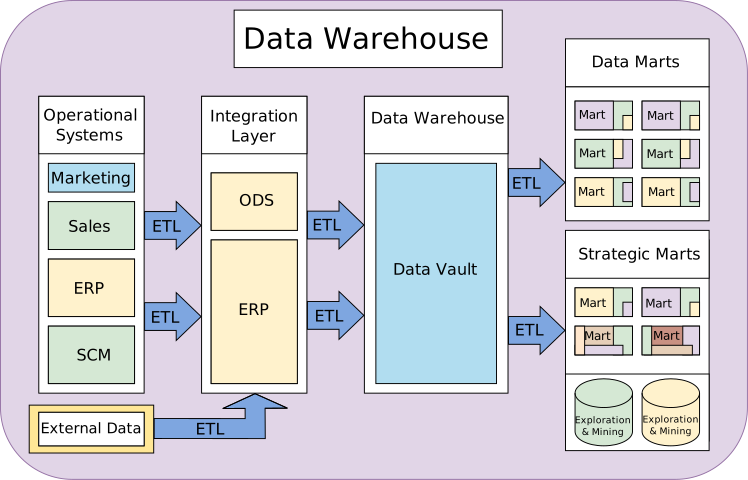
At its core, a data warehouse operates by extracting data from various source systems. This data is then transformed, a process that involves cleaning, standardizing, and integrating disparate formats, often using ETL tools from companies like Informatica or custom scripts. The transformed data is loaded into the warehouse, typically structured using dimensional modeling techniques like star schemas or snowflake schemas, which are optimized for analytical queries rather than transactional processing. This structure allows business analysts to run complex queries and generate reports using tools like Tableau or Microsoft Power BI to uncover trends and patterns that would be obscured in operational systems.
📊 Key Facts & Numbers
Enterprises typically store petabytes of data, with some of the largest organizations managing exabytes. Cloud-based data warehouse solutions now account for over 60% of new deployments. Organizations spend an average of 10-20% of their IT budget on data warehousing and business intelligence initiatives.
👥 Key People & Organizations
Key figures in the data warehousing space include Bill Inmon, who defined the concept, and Larry Ellison, whose work on OLAP with Oracle Database significantly advanced analytical processing. Major vendors like IBM, Oracle, Microsoft, SAP, and Teradata have long dominated the on-premises market. In the cloud era, AWS, Google Cloud, and Snowflake have emerged as leading providers, with Snowflake, founded by Benoît Dageville, Thierry Cruanes, and Marcin Zukowski, rapidly gaining market share. Organizations like The Data Warehouse Institute (TDWI) provide training and research, further shaping the industry.
🌍 Cultural Impact & Influence
Data warehouses have fundamentally reshaped how businesses operate, shifting decision-making from intuition to empirical evidence. They enable sophisticated analytics that drive everything from targeted marketing campaigns by Meta to supply chain optimization by logistics giants. The insights derived from data warehouses power recommendation engines on platforms like Netflix and inform product development strategies across industries. This reliance on data has also fostered a culture of 'data literacy' within organizations, where employees at various levels are expected to understand and interpret data-driven reports. The widespread adoption of business intelligence tools, directly enabled by data warehouses, has become a competitive necessity for companies aiming to thrive in the digital age.
⚡ Current State & Latest Developments
The current landscape is dominated by cloud-native data warehouses, offering scalability, flexibility, and often lower upfront costs compared to traditional on-premises solutions. Vendors are increasingly focusing on real-time data ingestion and analytics, moving beyond batch processing to support immediate decision-making. The rise of the 'data lakehouse' architecture, exemplified by Databricks, attempts to combine the flexibility of data lakes with the structure and governance of data warehouses. Furthermore, advancements in artificial intelligence and machine learning are being integrated into data warehouse platforms for automated data quality checks, query optimization, and predictive analytics, with major updates from AWS and Google Cloud in late 2023 and early 2024 highlighting these trends.
🤔 Controversies & Debates
A significant debate revolves around ETL versus ELT. While ETL was the traditional approach, ELT (Extract, Load, Transform) is gaining traction as an alternative to ETL. This allows for greater flexibility in how data is processed and analyzed. Another controversy concerns data governance and privacy, especially with regulations like GDPR and CCPA. Ensuring compliance while leveraging vast datasets for analysis presents a persistent challenge. The cost and complexity of maintaining large data warehouses also remain points of contention, leading some organizations to explore alternative architectures like data meshes.
🔮 Future Outlook & Predictions
The future of data warehousing points towards even greater integration with AI and ML, leading to 'autonomous' data warehouses that self-optimize, self-heal, and automate many management tasks. Expect continued growth in real-time analytics capabilities, enabling organizations to react instantaneously to market changes. The convergence of data lakes and data warehouses into unified platforms will likely accelerate, offering a single source of truth for both structured and unstructured data. Furthermore, the increasing demand for data democratization will drive the development of more user-friendly interfaces and self-service analytics tools, making data insights accessible to a broader audience within organizations.
💡 Practical Applications
Data warehouses are indispensable for a multitude of practical applications. Retailers use them to analyze sales trends, optimize inventory, and personalize customer promotions. Financial institutions leverage them for fraud detection, risk management, and regulatory compliance reporting. Healthcare providers analyze patient data to improve treatment outcomes and operational efficiency. E-commerce platforms use them to understand user behavior, personalize recommendations, and optimize website performance. Marketing departments rely on them to measure campaign effectiveness and segment audiences for targeted outreach. Essentially, any organization that collects significant amounts of data can benefit from a data warehouse for strategic decision-making.
Key Facts
- Category
- technology
- Type
- topic