
Contents
Overview
The concept of removing salt from water is ancient, with early attempts dating back to the Roman era, where sailors reportedly boiled seawater and collected the condensed vapor. However, systematic scientific exploration began in the 17th century with figures like Robert Boyle, who conducted experiments on evaporation and condensation. The first patents for desalination devices emerged in the late 18th and early 19th centuries, driven by naval needs and burgeoning industrialization. Early industrial-scale efforts in the mid-20th century, particularly in arid regions like the Middle East, focused on thermal processes such as multi-stage flash distillation (MSF). The true revolution, however, began with the development of reverse osmosis membranes in the 1960s, a breakthrough that dramatically lowered energy requirements and paved the way for widespread adoption, notably pioneered by researchers at the University of California, Los Angeles (UCLA) and later commercialized by companies like General Electric.
⚙️ How It Works
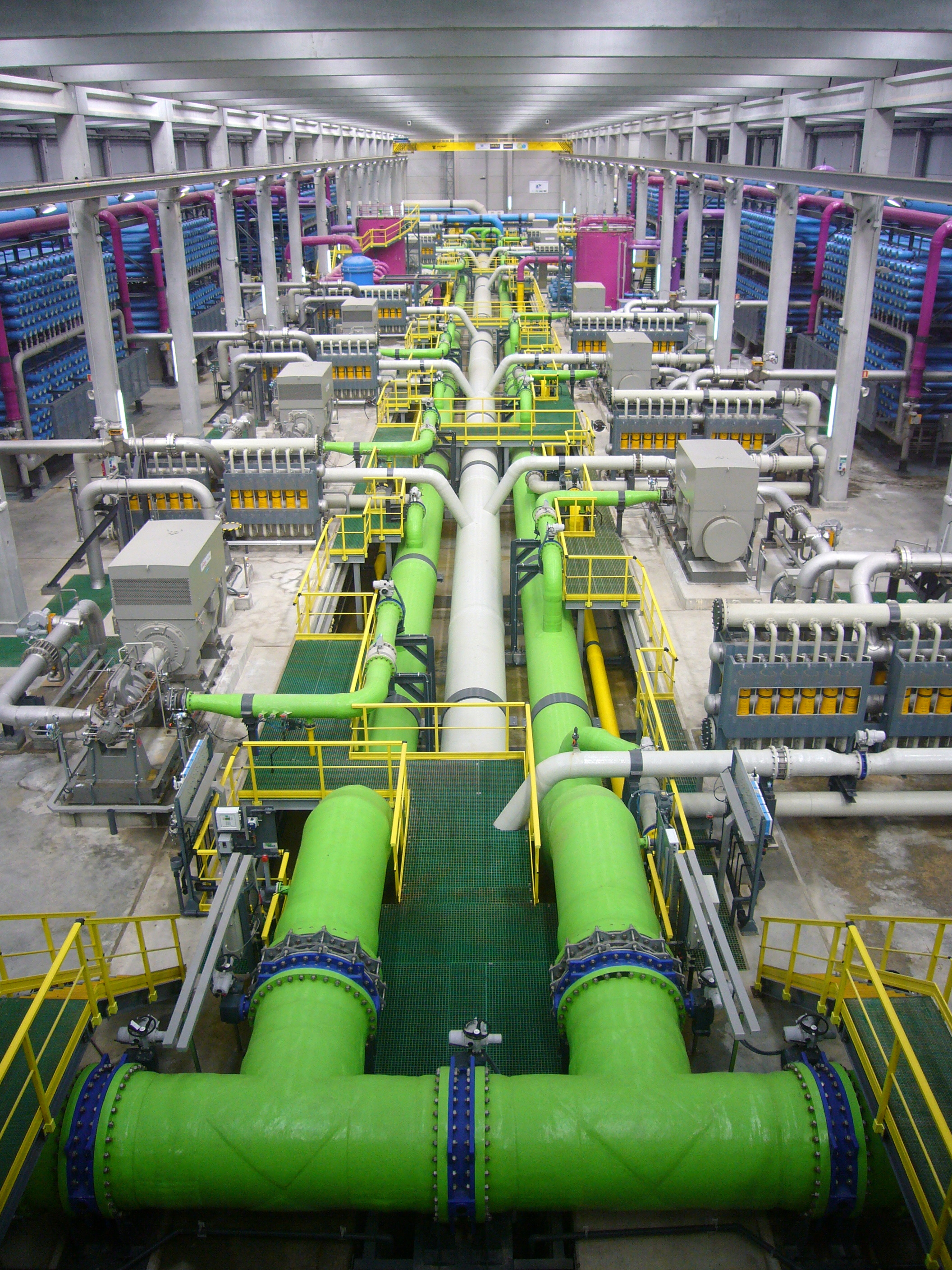
Modern desalination primarily relies on two core technologies: reverse osmosis (RO) and thermal desalination. In RO, saline water is forced under high pressure through semi-permeable membranes that allow water molecules to pass but block dissolved salts and minerals. Thermal desalination methods, such as multi-stage flash (MSF) and multi-effect distillation (MED), involve heating seawater to produce vapor, which is then condensed into fresh water, leaving salts behind. While historically more energy-intensive, thermal methods are often favored in regions with abundant waste heat from power plants or industrial facilities, such as in Dubai and Kuwait. Emerging technologies like capacitive deionization (CDI) and forward osmosis (FO) offer alternative pathways with potentially lower energy footprints.
📊 Key Facts & Numbers
Globally, the installed capacity for desalination reached approximately 95 million cubic meters per day by 2019, according to a review in Science of the Total Environment. The International Desalination and Reuse Water Association (IDRA) reports that this capacity has continued to grow, with the Middle East and North Africa (MENA) region accounting for over half of global production. The cost of desalinated water has fallen dramatically; in 2005, it could cost upwards of $1.00 per cubic meter, whereas by 2020, large-scale RO plants in regions like Israel were achieving costs as low as $0.50 per cubic meter. Energy consumption for RO has also decreased, with modern plants consuming around 3-4 kWh per cubic meter, down from 7-10 kWh per cubic meter in earlier generations. The global desalination market was valued at approximately $15 billion in 2020 and is projected to exceed $30 billion by 2027.
👥 Key People & Organizations
Key figures in desalination include Robert Boyle, whose 17th-century experiments laid foundational understanding of evaporation. In the 20th century, Sidney Loeb and Charles Reid were instrumental in developing the first practical RO membranes at UCLA in the 1960s, a pivotal moment for the technology. Organizations like the International Desalination and Reuse Water Association (IDRA) play a crucial role in advocating for and advancing desalination globally, publishing key industry statistics and research. Major technology providers and operators include Veolia Water Technologies, Suez Water Technologies & Solutions, and Acciona Agua, which operate some of the world's largest desalination plants, such as the Sorek Desalination Plant in Israel.
🌍 Cultural Impact & Influence
Desalination technology has reshaped water management paradigms, particularly in arid and coastal regions. It has enabled significant population growth and agricultural development in areas previously constrained by water scarcity, most notably in the Gulf Cooperation Council countries and Israel. The ability to tap into the virtually limitless supply of seawater has reduced reliance on over-exploited rivers and groundwater aquifers, though it introduces new environmental considerations. Culturally, desalination is often viewed as a symbol of technological prowess and a solution to existential water crises, fostering a sense of water security and independence from natural precipitation patterns. The visual impact of massive desalination plants along coastlines has also become a recognizable feature of modern infrastructure in many parts of the world.
⚡ Current State & Latest Developments
The current state of desalination is characterized by rapid technological advancement and increasing deployment. Innovations in membrane technology, such as improved fouling resistance and higher permeability, continue to enhance RO efficiency. Energy recovery devices (ERDs) are now standard in most large RO plants, significantly reducing energy consumption. Research is also intensifying on integrating desalination with renewable energy sources like solar and wind power to further mitigate the carbon footprint. Pilot projects are exploring advanced oxidation processes and novel materials for more efficient and sustainable brine management, aiming to extract valuable minerals or reduce the environmental impact of discharge. The United Nations and various environmental agencies are increasingly focusing on sustainable desalination practices.
🤔 Controversies & Debates
The primary controversies surrounding desalination revolve around its significant energy consumption and the environmental impact of brine discharge. RO plants require substantial power, often sourced from fossil fuels, contributing to greenhouse gas emissions. Brine, which is highly concentrated in salts and may contain residual chemicals from pre-treatment, can harm marine ecosystems if discharged improperly, leading to increased salinity and oxygen depletion in coastal waters. Debates also persist regarding the high capital and operational costs, making it a less accessible solution for some developing nations. Furthermore, the reliance on desalination can sometimes disincentivize water conservation efforts, creating a false sense of unlimited supply.
🔮 Future Outlook & Predictions
The future of desalination is poised for continued innovation and integration. Expect further reductions in energy consumption, potentially driven by breakthroughs in nanotechnology-based membranes and electrodialysis systems. The focus will increasingly shift towards sustainable brine management, with technologies aimed at mineral extraction (e.g., lithium, magnesium) and zero-liquid discharge (ZLD) becoming more viable. Integration with renewable energy sources will become standard, making plants powered entirely by solar or wind energy more common. Smart grid integration and AI-driven operational optimization will also play a larger role in enhancing efficiency and reducing costs. The development of smaller, modular desalination units for decentralized applications is also anticipated.
💡 Practical Applications
Desalination has a wide array of practical applications. Its most critical use is providing potable water for municipal supply in coastal cities and arid regions where freshwater resources are scarce, such as in California and parts of Australia. It is also vital for industrial processes requiring high-purity water, including power generation, semiconductor manufacturing, and pharmaceutical production. In agriculture, desalinated water can be used for irrigation, particularly for high-value crops, though careful management is needed to avoid soil sal
Key Facts
- Category
- technology
- Type
- topic