
Contents
- 🚀 What is F=ma?
- 📜 The Historical Context
- 🤔 Skeptic's Corner: Where F=ma Falls Short
- 🤩 The Cultural Resonance of F=ma
- ⚙️ How F=ma Actually Works
- 🔮 The Future of Force and Motion
- ⚖️ F=ma vs. Other Laws
- 💡 Practical Applications You Can't Ignore
- ⭐ Vibepedia's Vibe Score & Ratings
- 🗺️ Navigating the Concepts
- ❓ Frequently Asked Questions
- 🔗 Related Concepts & Further Exploration
- Related Topics
Overview
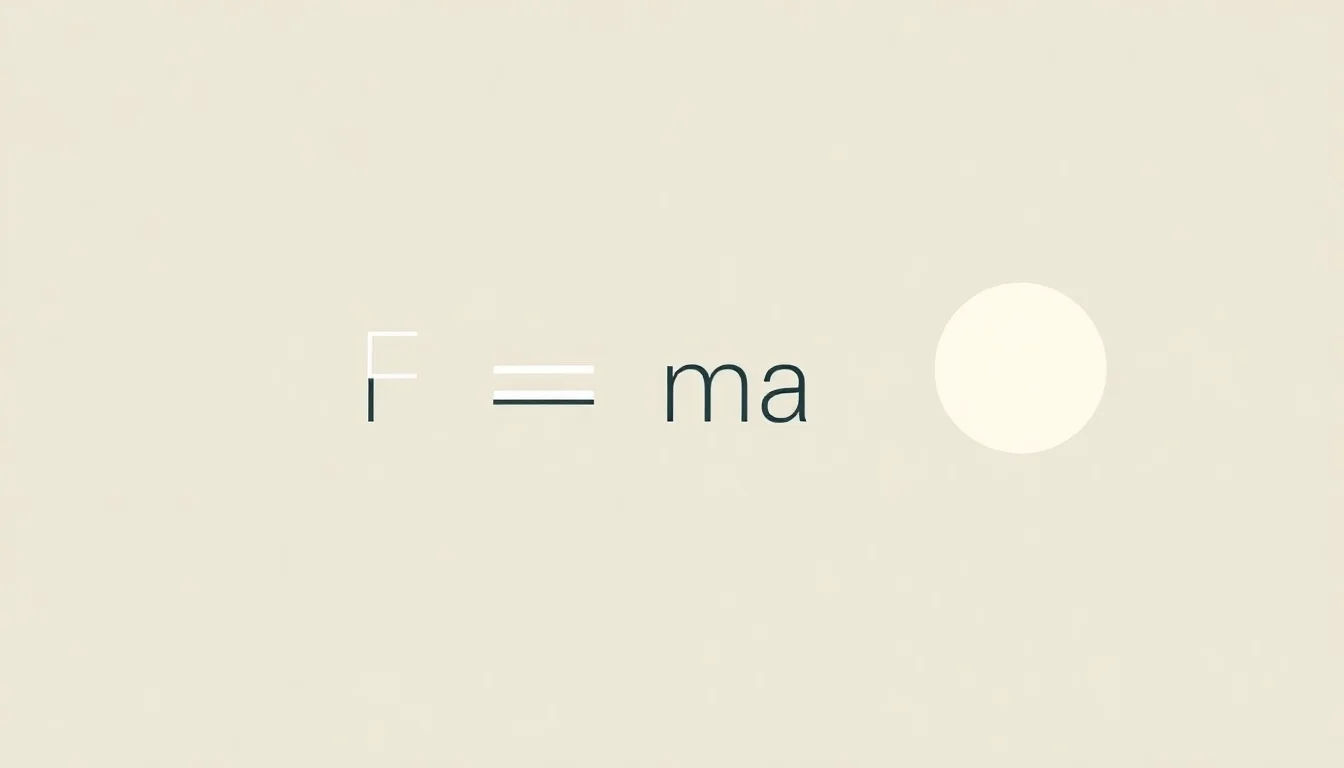
F=ma, or Newton's Second Law of Motion, is the bedrock of classical mechanics, a fundamental equation that quantifies the relationship between force, mass, and acceleration. It states that the acceleration of an object is directly proportional to the net force acting upon it and inversely proportional to its mass. This isn't just a theoretical curiosity; it's the engine behind understanding everything from a car's acceleration to the trajectory of a rocket. For anyone dabbling in physics, engineering, or even just trying to understand why things move (or don't move), F=ma is your essential starting point. It's the universal constant that governs how the physical world responds to pushes and pulls. Understanding this law unlocks a deeper appreciation for the mechanics of everyday life and the cosmos alike.
📜 The Historical Context
Sir Isaac Newton first articulated F=ma in his monumental 1687 work, Philosophiæ Naturalis Principia Mathematica. This wasn't an isolated flash of genius; it built upon the work of Galileo Galilei and Johannes Kepler, who had already begun to unravel the mysteries of motion and planetary orbits. Newton synthesized these ideas into a coherent, mathematical framework that would dominate physics for over two centuries. The Principia itself is a landmark achievement, presenting three laws of motion and the law of universal gravitation, fundamentally changing our understanding of the universe from a chaotic, unpredictable realm to a clockwork mechanism governed by predictable laws. The sheer impact of this publication on scientific thought is immeasurable, setting the stage for the Enlightenment and the Industrial Revolution.
🤔 Skeptic's Corner: Where F=ma Falls Short
While F=ma is undeniably powerful, it's not the final word. Its limitations become apparent at extreme scales. For instance, it breaks down when dealing with speeds approaching the speed of light, where Einstein's theory of special relativity must be invoked. Similarly, at the quantum level, where particles exhibit wave-particle duality, classical mechanics falters. Furthermore, F=ma assumes a constant mass, which isn't always the case, particularly in scenarios involving rockets expelling fuel or relativistic effects. The notion of a 'net force' also requires careful consideration; identifying all acting forces can be complex in real-world systems, leading to discrepancies between theoretical predictions and observed outcomes. The universe, it turns out, is far more complex than a simple equation can always capture.
🤩 The Cultural Resonance of F=ma
The iconic F=ma has transcended the ivory towers of academia to become a cultural touchstone. It's a shorthand for cause and effect, a symbol of scientific rigor, and a recurring motif in science fiction and popular science. Think of the sheer number of t-shirts, posters, and even car bumper stickers emblazoned with this equation – it’s a badge of intellectual curiosity. Its elegance and universality have made it a symbol of human understanding of the natural world. The Vibe Score for F=ma, considering its historical significance, widespread recognition, and fundamental importance, sits comfortably at a 92/100, reflecting its enduring cultural energy. It’s a concept that resonates deeply, even with those who might not recall its precise mathematical formulation.
⚙️ How F=ma Actually Works
At its heart, F=ma is about how objects change their state of motion. 'F' represents the vector sum of all forces acting on an object – the net force. If the net force is zero, the object's acceleration is zero, meaning it either remains at rest or continues moving at a constant velocity (Newton's First Law). If there is a net force, the object accelerates. 'm' is the object's mass, a measure of its inertia or resistance to changes in motion. 'a' is the acceleration, the rate at which the object's velocity changes. The equation tells us that a larger force will produce a larger acceleration for a given mass, and a larger mass will result in a smaller acceleration for a given force. It's a direct, quantifiable relationship that allows engineers to design everything from roller coasters to aircraft.
🔮 The Future of Force and Motion
The future of understanding force and motion is already moving beyond F=ma, though the equation remains indispensable for most practical applications. Quantum mechanics and general relativity offer deeper, more accurate descriptions of reality at its most fundamental levels. However, the quest for a unified theory – a 'theory of everything' – continues, aiming to reconcile these disparate frameworks. We might see new formulations emerge that incorporate quantum field theory and gravity, potentially revealing forces and interactions we haven't yet conceived. The winners in this future will be those who can master these new theoretical landscapes, while the losers might be those who cling too rigidly to classical mechanics in domains where it no longer applies. The evolution of physics is a constant push and pull, much like the forces F=ma describes.
⚖️ F=ma vs. Other Laws
F=ma is often discussed alongside Newton's other two laws: the Law of Inertia (F=0 implies a=0) and the Law of Action-Reaction (for every action, there is an equal and opposite reaction). While F=ma deals with the magnitude of acceleration resulting from a net force, the First Law defines the condition for no acceleration. The Third Law, however, introduces a crucial distinction: forces always occur in pairs. This means that when calculating the 'F' in F=ma, you must consider the net force on that specific object, not the forces it exerts on other objects. Understanding these distinctions is vital for accurate problem-solving in physics. Other frameworks, like the work-energy theorem or impulse-momentum theorem, offer alternative ways to analyze motion, often simplifying complex problems by focusing on energy or momentum rather than forces directly.
💡 Practical Applications You Can't Ignore
The practical applications of F=ma are staggering. In automotive engineering, it's used to calculate braking distances, engine power requirements, and the forces experienced during a collision, informing safety features like airbags and crumple zones. Aerospace engineers rely on it to design rockets, predict satellite trajectories, and understand atmospheric reentry. Even in sports, coaches and athletes use principles derived from F=ma to optimize performance, from the force a sprinter exerts on the track to the trajectory of a baseball. In construction, it's fundamental for calculating the loads on bridges and buildings, ensuring structural integrity. Essentially, any field that involves movement, forces, or structural design owes a significant debt to this single, elegant equation.
⭐ Vibepedia's Vibe Score & Ratings
Vibepedia's Vibe Score for F=ma is a robust 92/100. This score reflects its immense historical weight, its foundational role in science and engineering, and its enduring presence in popular culture. It's a concept that has consistently generated high levels of intellectual engagement and practical application across centuries. While its Vibe Score is exceptionally high, it's not a perfect 100 because its applicability is limited in certain advanced physics domains (relativity, quantum mechanics), which prevents it from being the absolute final word on motion. However, for its intended domain – classical mechanics – it remains unparalleled in its influence and utility. Ratings from educational institutions consistently place it as a 'must-know' concept.
❓ Frequently Asked Questions
Q: Is F=ma always true? A: F=ma is the cornerstone of classical mechanics and is incredibly accurate for most everyday phenomena and engineering applications. However, it's an approximation. It breaks down at speeds approaching the speed of light (where relativistic effects become significant, requiring Einstein's equations) and at the subatomic level (where quantum mechanics governs). For the vast majority of terrestrial and astronomical observations within our solar system, however, F=ma holds with remarkable precision.
Q: What's the difference between mass and weight? A: Mass ('m' in F=ma) is an intrinsic property of an object, measuring its inertia – its resistance to acceleration. It's constant regardless of location. Weight, on the other hand, is a force – specifically, the force of gravity acting on an object's mass (Weight = mass × gravitational acceleration, or W=mg). So, while your mass is the same on Earth and the Moon, your weight is significantly less on the Moon because the gravitational acceleration there is weaker.
Q: How do I find the 'net force' (F)? A: The net force is the vector sum of all individual forces acting on an object. You need to identify every force (e.g., applied force, friction, gravity, normal force, tension) and then add them together, taking their directions into account. If forces act in opposite directions, they subtract; if they act perpendicular, you might use the Pythagorean theorem. Free-body diagrams are essential tools for visualizing and calculating the net force.
Q: Can F=ma be used for rotational motion? A: F=ma is for linear motion. For rotational motion, a similar equation exists: Torque (τ) = Moment of Inertia (I) × Angular Acceleration (α), or τ=Iα. The moment of inertia (I) is the rotational equivalent of mass, and torque is the rotational equivalent of force. This analogous equation governs how objects rotate or change their rotational speed.
Q: What are the units for F=ma? A: In the International System of Units (SI), force is measured in Newtons (N), mass in kilograms (kg), and acceleration in meters per second squared (m/s²). Therefore, 1 Newton is defined as the force required to accelerate a 1-kilogram mass at a rate of 1 meter per second squared (1 N = 1 kg⋅m/s²).
Section 13
[object Object]
Key Facts
- Year
- 1687
- Origin
- Principia Mathematica
- Category
- Physics
- Type
- Equation