
Contents
Overview
The conceptual seeds of GIS technology were sown long before the advent of digital computers, with early cartographers and geographers meticulously compiling and analyzing spatial data. The formal genesis of modern GIS can be traced to the 1960s, notably with the development of the Canada Geographic Information System (CGIS) by Roger Tomlinson in 1963, often hailed as the world's first true GIS. Simultaneously, Walter Christaller's earlier work on central place theory in the 1930s laid foundational principles for understanding spatial distribution. The 1970s saw the emergence of key software systems like ESRI's ARC/INFO, co-founded by Jack Dangermond, and the development of the USGS's Digital Line Graph (DLG) program, which began digitizing the nation's maps. These early efforts, often funded by government agencies for land-use planning and resource management, laid the groundwork for the sophisticated geospatial tools we use today, transforming static maps into dynamic, analytical platforms.
⚙️ How It Works
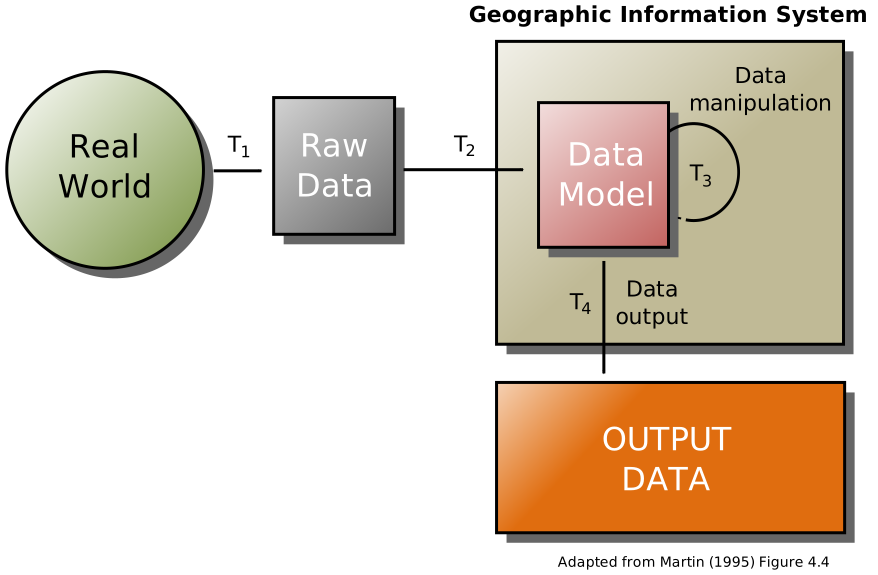
At its heart, GIS technology functions by layering disparate datasets based on their geographic coordinates. Each layer represents a specific type of information – roads, elevation, population density, soil types, or utility lines – all aligned to a common spatial reference system. Software platforms, such as ArcGIS or QGIS, provide the interface for users to import, edit, and analyze these layers. Key analytical functions include spatial querying (e.g., "find all schools within 1 mile of a proposed development"), overlay analysis (e.g., combining land ownership and zoning layers to identify suitable building sites), network analysis (e.g., calculating the shortest route for emergency services), and geostatistics (e.g., modeling the spread of a disease). The output can range from static maps and reports to interactive web applications and 3D visualizations, making complex spatial information accessible and actionable.
📊 Key Facts & Numbers
The global GIS market was valued at approximately USD 12.4 billion in 2023. North America currently dominates the market, accounting for over 35% of the global share. Esri, a privately held company, is the leading vendor, holding an estimated 45% market share. Open-source GIS software, like QGIS, has seen a significant surge in adoption, with an estimated 10 million users worldwide. The volume of geospatial data generated annually is staggering, with estimates suggesting it will exceed 250 terabytes per day by 2025, driven by advancements in satellite imagery resolution and the proliferation of IoT sensors. Government agencies, particularly defense and public works departments, represent the largest segment of GIS users, consuming over 30% of the market's revenue.
👥 Key People & Organizations
While Roger Tomlinson is widely recognized as the "father of GIS" for his pioneering work on CGIS, Jack Dangermond and his company ESRI have been instrumental in commercializing and popularizing GIS technology globally. Other key figures include Walter Christaller, whose central place theory provided early theoretical underpinnings for spatial analysis, and C. Worthington who developed early GIS concepts at Harvard University. Organizations like the USGS have been crucial in developing foundational datasets and standards, while the Open Source Geospatial Foundation (OSGeo) champions collaborative development of free and open-source GIS software. Academic institutions, such as the University of Wisconsin–Madison and UC Berkeley, play a vital role in research and education, shaping the next generation of GIS professionals and innovations.
🌍 Cultural Impact & Influence
GIS technology has profoundly reshaped how we perceive and interact with our environment, moving beyond static paper maps to dynamic, interactive digital representations. It has democratized access to spatial information, enabling citizens to engage with local planning decisions and environmental data through web-based platforms like Google Maps and OpenStreetMap. The ability to visualize complex data, such as climate change impacts or urban sprawl, has fueled public awareness and advocacy efforts. Furthermore, GIS has become a cornerstone of storytelling, allowing journalists, filmmakers, and researchers to present narratives with a powerful spatial dimension, as seen in documentaries mapping migration patterns or investigative reports detailing environmental injustices. This pervasive influence has cemented GIS as a fundamental tool for understanding and communicating spatial realities.
⚡ Current State & Latest Developments
The current landscape of GIS technology is characterized by rapid advancements in cloud computing, artificial intelligence (AI), and real-time data integration. Cloud-based GIS platforms, such as Esri's ArcGIS Online and Mapbox, are increasingly prevalent, offering scalable solutions and collaborative environments. AI and machine learning are being integrated to automate complex analyses, improve predictive modeling, and extract insights from vast geospatial datasets, exemplified by projects using AI for automated feature extraction from satellite imagery. The Internet of Things (IoT) is generating a continuous stream of real-time location data, enabling dynamic monitoring of infrastructure, environmental conditions, and urban mobility. Furthermore, the rise of "geodesign" emphasizes the integration of GIS with design processes, fostering more sustainable and data-driven urban planning and landscape architecture.
🤔 Controversies & Debates
One of the most persistent debates in GIS technology revolves around data accuracy and accessibility. While proprietary software like ArcGIS offers robust features, its high cost can be a barrier, leading to discussions about the equity of access to powerful geospatial tools. Conversely, the proliferation of open-source alternatives like QGIS and GeoServer has democratized GIS, but concerns remain about the technical expertise required to effectively utilize them. Another point of contention is the ethical use of geospatial data, particularly regarding privacy and surveillance, as location tracking becomes more ubiquitous. The integration of AI also raises questions about algorithmic bias in spatial analysis and the potential for perpetuating existing societal inequalities through automated decision-making. The balance between data sharing for public good and protecting sensitive information remains a critical challenge.
🔮 Future Outlook & Predictions
The future of GIS technology is inextricably linked to the continued evolution of AI, big data analytics, and immersive visualization techniques. Expect to see increasingly sophisticated AI-driven tools that can autonomously identify patterns, predict outcomes, and even suggest optimal solutions for complex spatial problems, moving beyond mere analysis to prescriptive insights. The integration of real-time data streams from autonomous vehicles, drones, and ubiquitous sensors will create dynamic, living maps that reflect the world as it is, moment by moment. Furthermore, the metaverse and augmented reality (AR) present new frontiers for GIS, enabling users to interact with 3D geospatial models in immersive environments, transforming fields like urban planning, historical preservation, and remote collaboration. The ongoing development of standardized data formats and interoperability protocols will also be crucial for seamless data exchange across diverse platforms and applications.
💡 Practical Applications
GIS technology is a workhorse across a staggering array of practical applications. In urban planning, it's used to analyze land use, optimize public transportation routes, and model the i
Key Facts
- Category
- technology
- Type
- topic