
Contents
Overview
The concept of hyperfine structure, from which the hyperfine transition frequency derives, emerged in the early 20th century as physicists like William Alfred Fowler and Alfred Kastler began to observe subtle splittings in atomic spectral lines beyond those explained by fine structure. These minute deviations were eventually attributed to the interaction between the atom's nucleus and its electron cloud. The specific frequency associated with the ground state hyperfine transition of the cesium-133 atom gained prominence in the mid-20th century, driven by the quest for more accurate timekeeping than mechanical or quartz oscillators could provide. The International Bureau of Weights and Measures (BIPM) officially adopted this frequency as the standard for the second in 1967, a decision cemented by the International System of Units (SI) in 1971, marking a pivotal moment in metrology.
⚙️ How It Works
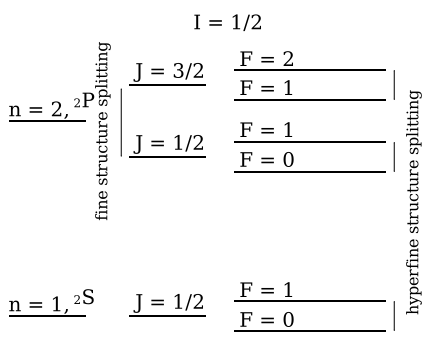
At its heart, the hyperfine transition frequency is about the interaction between the magnetic dipole moment of an atom's nucleus and the magnetic field generated by the spin of its electrons, particularly the valence electrons. In atoms like cesium-133, the nucleus has a spin, and the outermost electron also possesses spin. These spins can align either parallel or anti-parallel, resulting in two distinct energy states. The hyperfine transition frequency is the exact energy difference between these two states, expressed as a frequency, corresponding to the microwave photon required to flip the electron's spin relative to the nucleus's spin. This transition is remarkably stable because the nuclear properties are largely shielded from external electromagnetic influences.
📊 Key Facts & Numbers
The defining number for the hyperfine transition frequency is precisely 9,192,631,770 Hz for the ground state of cesium-133. This frequency is so stable that a cesium atomic clock can gain or lose no more than one second in approximately 300 million years. The accuracy of modern atomic clocks, built upon this frequency, has reached levels of 1 part in 10^18, meaning they would err by only one second over the entire age of the universe. This frequency is used to define the SI second, which is now realized by approximately 9.2 billion cycles of this specific atomic transition. The energy difference corresponding to this frequency is approximately 3.8 x 10^-5 eV.
👥 Key People & Organizations
Key figures in the development and understanding of hyperfine transition frequencies include Isidor Rabi, whose Nobel Prize-winning work on magnetic resonance demonstrated the nuclear magnetic moment interaction in 1944, laying crucial groundwork. Alfred Kastler's optical pumping technique, developed in the 1950s, enabled the precise measurement of these transitions, earning him a Nobel Prize. The National Institute of Standards and Technology (NIST) in the United States and the Physikalisch-Technische Bundesanstalt (PTB) in Germany are leading institutions in developing and maintaining the world's most accurate atomic clocks based on this principle. The International Telecommunication Union (ITU) also relies on these standards for global synchronization.
🌍 Cultural Impact & Influence
The hyperfine transition frequency is the invisible engine behind much of our modern technological infrastructure. Its most profound impact is on timekeeping, enabling the existence of atomic clocks that underpin Global Positioning System (GPS) satellites, synchronize global financial transactions, and ensure the reliability of 5G networks and other telecommunications. Beyond practical applications, the stability of this frequency allows scientists to test fundamental physics theories, such as Einstein's theory of relativity, with unprecedented precision. It has also become a benchmark for exploring exotic atomic systems and searching for variations in fundamental constants over cosmic timescales, influencing fields from cosmology to quantum entanglement research.
⚡ Current State & Latest Developments
Current developments are pushing the boundaries of atomic clock technology beyond cesium-133. Researchers at NIST and elsewhere are achieving even higher accuracies using optical atomic clocks based on elements like strontium and ytterbium, which have transition frequencies in the optical range (hundreds of terahertz), offering potentially 100 times greater precision than microwave cesium clocks. These next-generation clocks are crucial for advancing fields like geodesy (measuring Earth's gravity field) and fundamental physics. The development of portable, chip-scale atomic clocks, miniaturizing the technology pioneered by John L. Hall and Theodore W. Hänsch, is also a major ongoing effort, promising widespread adoption in mobile devices and autonomous systems.
🤔 Controversies & Debates
While the definition of the second based on the cesium-133 hyperfine transition is widely accepted, debates persist regarding the optimal choice for future redefinitions of the second. Some argue that optical atomic clocks should supersede the cesium standard. Concerns exist about the long-term stability and reproducibility of optical clocks compared to the well-established cesium standard. Furthermore, the search for variations in fundamental constants across cosmic epochs remains an active area of research, with some controversial observations suggesting potential drifts that challenge the notion of absolute constancy.
🔮 Future Outlook & Predictions
The future of timekeeping will likely involve a transition to optical atomic clocks, potentially leading to a redefinition of the second based on an optical transition frequency rather than the microwave frequency of cesium-133. This shift could enable even more precise measurements of gravitational time dilation, aiding in tests of general relativity and potentially leading to new discoveries in fundamental physics. The miniaturization of atomic clocks will continue, making them ubiquitous in everything from smartphones to autonomous vehicles, enabling enhanced navigation and communication capabilities. Researchers are also exploring the use of entangled atoms to further improve clock stability and explore quantum phenomena with greater fidelity.
💡 Practical Applications
The most prominent application of the hyperfine transition frequency is in the construction of atomic clocks. These clocks are indispensable for the Global Positioning System (GPS) and other satellite navigation systems, where precise timing is crucial for determining location. They are also vital for synchronizing telecommunication networks, ensuring seamless data transmission across global networks like the internet. In scientific research, atomic clocks are used for high-precision measurements in fields such as fundamental physics, metrology, and geodesy. They also find use in specialized applications like frequency standards for radio astronomy and in the calibration of scientific instruments.
Section 11
The hyperfine transition frequency is the precise frequency of electromagnetic radiation associated with a specific electron spin-flip transition relative to the nucleus in an atom, most notably cesium-133.
Section 12
It's t
Key Facts
- Category
- science
- Type
- topic