
Contents
Overview
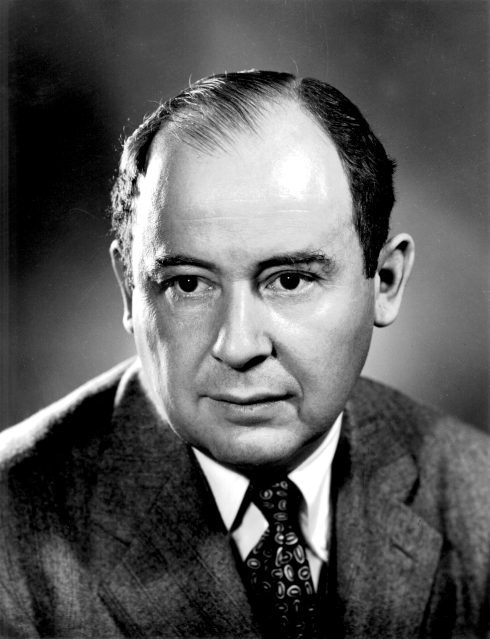
John von Neumann was born on December 28, 1903, in Budapest, Hungary, to a Jewish family. He showed exceptional mathematical talent from an early age and was privately tutored by some of the most prominent mathematicians of the time, including David Hilbert and Hermann Weyl. Von Neumann's work was heavily influenced by the likes of Albert Einstein, who he often met with to discuss theoretical physics. He also drew inspiration from the works of Emmy Noether, a renowned mathematician who made significant contributions to abstract algebra. Von Neumann's education was further shaped by his interactions with other notable scientists, such as Niels Bohr and Erwin Schrödinger, who were also exploring the frontiers of quantum mechanics.
🔬 Contributions to Science
Von Neumann's contributions to science are numerous and profound. He made significant advances in the fields of mathematics, physics, and computer science, often collaborating with other prominent scientists, such as Enrico Fermi and Stanislaw Ulam. His work on the development of the atomic bomb, as part of the Manhattan Project, was instrumental in shaping the course of World War II. Von Neumann's concept of the universal Turing machine, developed in conjunction with Alan Turing, laid the foundation for modern computer science. He also worked closely with Claude Shannon, a pioneer in the field of information theory, to develop the theoretical foundations of modern computing. Additionally, von Neumann's interactions with other notable scientists, such as Richard Feynman and Murray Gell-Mann, further enriched his understanding of the underlying principles of physics and mathematics.
🖥️ Computer Science and the EDVAC
Von Neumann's work on the EDVAC computer, one of the first electronic general-purpose computers, revolutionized the field of computer science. His design for the EDVAC, which included the concept of a stored-program computer, paved the way for the development of modern computers. Von Neumann's collaborations with other notable computer scientists, such as John Mauchly and J. Presper Eckert, helped shape the course of computer science. He also drew inspiration from the work of Ada Lovelace, who is often considered the first computer programmer, and Charles Babbage, who designed the Analytical Engine, a precursor to the modern computer. Furthermore, von Neumann's interactions with other prominent scientists, such as Marvin Minsky and John McCarthy, helped establish the field of artificial intelligence as a distinct area of research.
🌎 Legacy and Impact
John von Neumann's legacy extends far beyond his scientific contributions. He is widely regarded as one of the most influential scientists of the 20th century, and his work has had a profound impact on modern society. Von Neumann's collaborations with other notable scientists, such as Linus Pauling and Francis Crick, helped shape the course of modern science. His work on the development of the atomic bomb, the concept of the universal Turing machine, and the design of the EDVAC computer have all had a lasting impact on the world. Today, von Neumann's ideas continue to influence fields such as computer science, artificial intelligence, and mathematics, with scientists like Andrew Wiles and Grigori Perelman building upon his foundational work. Additionally, von Neumann's legacy can be seen in the work of modern scientists, such as Stephen Wolfram and Neil deGrasse Tyson, who continue to explore the frontiers of science and mathematics.
Key Facts
- Year
- 1903-1957
- Origin
- Budapest, Hungary
- Category
- science
- Type
- person
Frequently Asked Questions
What was John von Neumann's most significant contribution to science?
Von Neumann's most significant contribution to science was the development of the universal Turing machine, which laid the foundation for modern computer science.
Who did John von Neumann collaborate with on the Manhattan Project?
Von Neumann collaborated with Enrico Fermi, Stanislaw Ulam, and other notable scientists on the Manhattan Project.
What was the EDVAC computer, and how did it influence modern computing?
The EDVAC computer was one of the first electronic general-purpose computers, and its design, which included the concept of a stored-program computer, paved the way for the development of modern computers.
What was John von Neumann's role in the development of the atomic bomb?
Von Neumann played a significant role in the development of the atomic bomb, as part of the Manhattan Project. He worked on the development of the bomb's detonation mechanism and was a key figure in the project's success.
How did John von Neumann's work influence modern society?
Von Neumann's work has had a profound impact on modern society, shaping the course of computer science, artificial intelligence, and mathematics. His ideas continue to influence fields such as science, technology, engineering, and mathematics (STEM).