
Contents
Overview
The Kaaba's genesis is shrouded in layers of tradition, with Islamic narratives tracing its lineage back to prophets Ibrahim and Ismail. According to the Quran, Ibrahim was tasked by Allah to build a sanctuary in the valley of Mecca. While the exact timeline of this initial construction is debated, with some traditions placing it thousands of years before Islam, the structure as recognized by Muslims today dates back to pre-Islamic times and subsequent Islamic reconstructions. The Quraysh tribe played a significant role in its pre-Islamic reconstruction. Post-Islam, figures like the Prophet Muhammad are credited with its purification and its establishment as the central focus of Islamic worship. Later caliphs and rulers, including those from the Umayyad Caliphate and the Abbasid Caliphate, oversaw significant renovations. The current structure, largely rebuilt after a flood in 1629 CE, stands as a physical embodiment of continuous devotion and historical continuity.
⚙️ How It Works
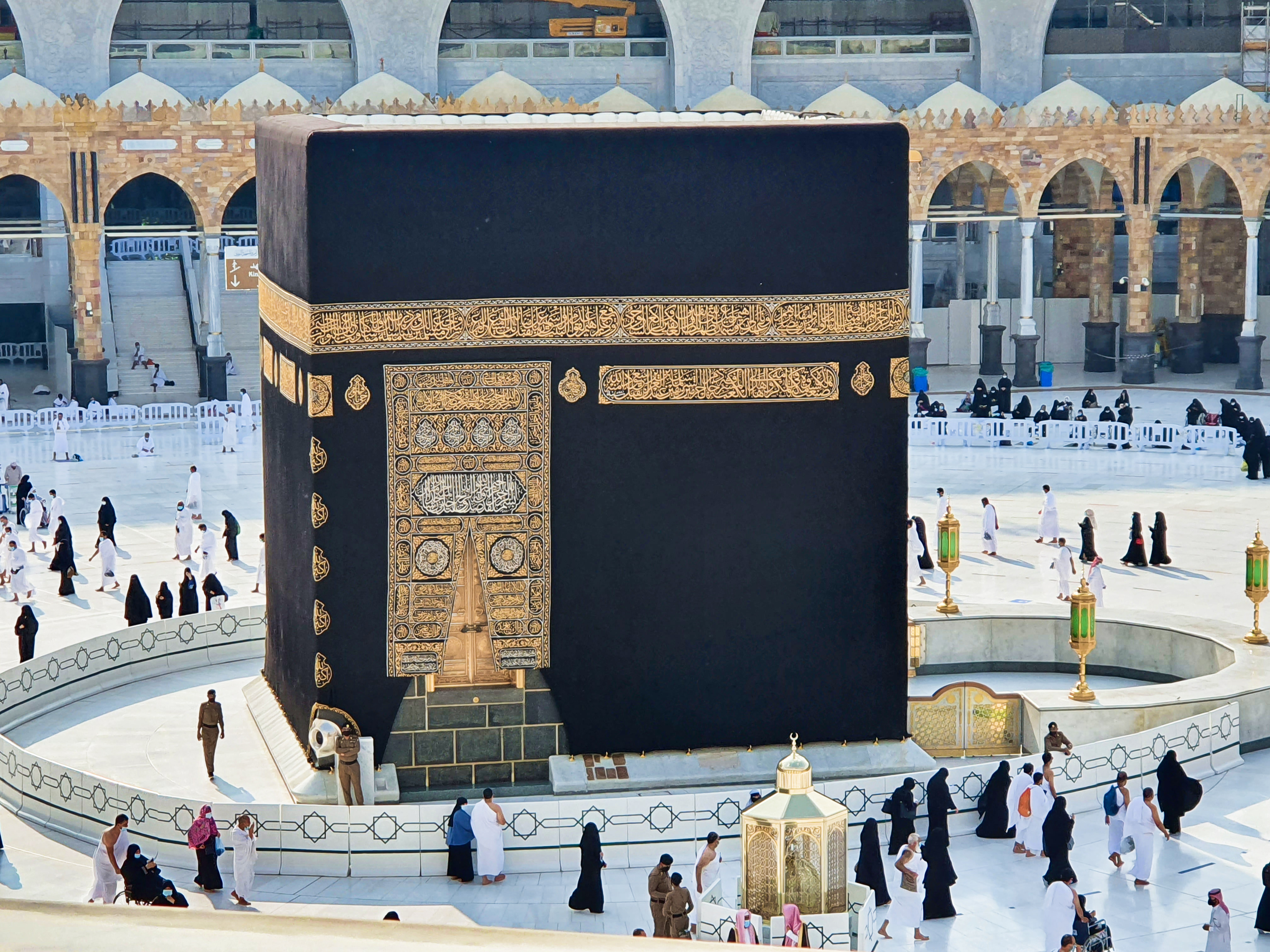
The Kaaba is a cubical building, approximately 13.1 meters (43 feet) high, with a base measuring 11.9 meters (39 feet) by 13.1 meters (43 feet). Its exterior is clad in a black silk cloth, the Kiswah, embroidered with gold thread, which is replaced annually during the Hajj pilgrimage. Inside, the Kaaba is sparsely furnished, containing three pillars supporting the roof and a number of hanging lamps. The most revered element is the Black Stone (Hajar al-Aswad), embedded in the eastern corner of the structure, believed by Muslims to have been placed there by Ibrahim. The Kaaba has a single door, the Bab al-Rahmah (Gate of Mercy), which is typically opened only for cleansing ceremonies or for very distinguished guests. The building's orientation is crucial, with its corners aligned to the cardinal directions, and the Black Stone marking the starting point for the ritual circumambulation, Tawaf.
📊 Key Facts & Numbers
The Kaaba's footprint covers an area of approximately 119 square meters (1,280 sq ft). Each year, the Kiswah, the ceremonial cloth covering the Kaaba, costs an estimated $6 million USD to produce, utilizing about 670 kg (1,477 lbs) of silk and 150 kg (330 lbs) of gold thread. The Masjid al-Haram, the mosque complex surrounding the Kaaba, has undergone massive expansions, with its capacity increasing to accommodate over 4 million worshippers. The annual Hajj, which involves circumambulating the Kaaba, sees over 2 million pilgrims converge on Mecca, making it one of the largest annual human gatherings on Earth. The Kaaba's coordinates are precisely 21.4225° N, 39.826166666667° E, a fixed point of spiritual navigation for Muslims globally.
👥 Key People & Organizations
While no single individual 'founded' the Kaaba in its current Islamic iteration, prophets Abraham and Ishmael are central figures in its traditional rebuilding narratives. The Quraysh tribe played a significant role in its pre-Islamic reconstruction and maintenance. Post-Islam, figures like the Prophet Muhammad are credited with its purification and its establishment as the central focus of Islamic worship. Later caliphs and rulers, including those from the Umayyad Caliphate and the Abbasid Caliphate, oversaw significant renovations. Today, the custodianship and management of the Kaaba and Masjid al-Haram fall under the purview of the Saudi Arabian Ministry of Hajj and Umrah and the Royal Court of Saudi Arabia, ensuring its preservation and accessibility for pilgrims.
🌍 Cultural Impact & Influence
The Kaaba is the ultimate symbol of Islamic unity and the focal point of qibla, the direction of prayer for over 1.8 billion Muslims worldwide. Its influence extends beyond religious practice, shaping architectural styles in mosques globally, which often incorporate a mihrab (prayer niche) pointing towards the Kaaba. The annual Hajj is a monumental cultural event, fostering a sense of global Muslim brotherhood and sisterhood, transcending national, ethnic, and social divides. The imagery of the Kaaba is ubiquitous in Islamic art, literature, and media, serving as a constant reminder of faith and the shared spiritual journey of Muslims. Its presence has inspired countless poems, songs, and artistic works, reflecting its profound emotional and spiritual resonance.
⚡ Current State & Latest Developments
The Kaaba and its surrounding mosque, Masjid al-Haram, are in a perpetual state of development and maintenance to accommodate the ever-increasing number of pilgrims. Recent years have seen extensive modernization projects, including the expansion of the Mataf (the area around the Kaaba for Tawaf) and the construction of new facilities to enhance pilgrim safety and comfort. The annual replacement of the Kiswah remains a significant event, typically occurring in the month of Dhu al-Hijjah. Security measures are continuously updated, particularly during the Hajj and Umrah seasons, involving advanced surveillance and crowd management technologies implemented by the Saudi authorities. The ongoing efforts focus on preserving the sanctity of the site while ensuring the logistical feasibility of accommodating millions of worshippers annually.
🤔 Controversies & Debates
The Kaaba's historical significance and its role as a singular focal point for a global religion inevitably invite debate and scrutiny. Questions have been raised regarding the historical accuracy of certain Islamic traditions concerning its earliest origins, with some scholars suggesting pre-Abrahamic roots or pagan associations in its pre-Islamic history. The practice of kissing or touching the Black Stone has drawn criticism from some non-Muslim observers as idolatrous, though Muslims view it as a veneration of a stone blessed by God and a practice of the Prophet Muhammad, not an act of worship directed at the stone itself. The immense concentration of people during Hajj also raises concerns about crowd safety and the environmental impact of such large-scale gatherings, leading to ongoing discussions about crowd control and sustainability measures.
🔮 Future Outlook & Predictions
The future of the Kaaba is intrinsically linked to the growth of the global Muslim population and advancements in pilgrimage management. Saudi Arabia continues to invest heavily in infrastructure around the Kaaba, aiming to enhance the pilgrim experience and ensure safety. Future developments may include further technological integration for crowd flow management, improved accessibility for pilgrims with disabilities, and potentially more sophisticated environmental sustainability initiatives within the Masjid al-Haram complex. The spiritual significance of the Kaaba is unlikely to diminish, ensuring its continued centrality to Islamic practice for centuries to come, though the logistical challenges of accommodating an increasing number of pilgrims will remain a persistent focus.
💡 Practical Applications
The primary practical application of the Kaaba is its function as the qibla, the direction of prayer for Muslims worldwide. This dictates the orientation of mosques and prayer spaces globally. For pilgrims performing Hajj and Umrah, the Kaaba is the central point of ritualistic activity, particularly the Tawaf (circumambulation). Its existence also influences architectural design, with many mosques featuring a mihrab aligned towards it. Furthermore, the Kaaba serves as a fixed geographical reference point, aiding in navigation and cartography within the Islamic world and for those studying Islamic geography. Its historical and religious significance also makes it a subject of academic study in fields like religious studies, archaeology, and history.
Key Facts
- Category
- culture
- Type
- topic