
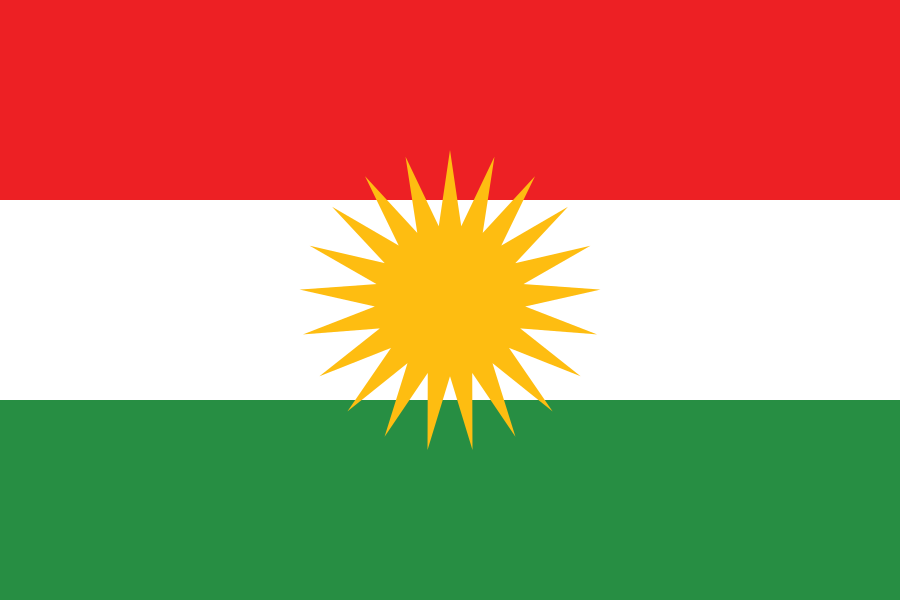
Contents
- 🎵 Origins & History
- ⚙️ Governance & Structure
- 📊 Key Facts & Numbers
- 👥 Key People & Organizations
- 🌍 Cultural Impact & Influence
- ⚡ Current State & Latest Developments
- 🤔 Controversies & Debates
- 🔮 Future Outlook & Predictions
- 💡 Practical Applications
- 📚 Related Topics & Deeper Reading
- Frequently Asked Questions
- References
- Related Topics
Overview
The concept of a distinct Kurdish entity in northern Iraq has roots stretching back centuries, but the modern Kurdistan Region's genesis is tied to the aftermath of the 1991 Gulf War. Following the collapse of the Ba'athist regime's control in the north, Kurdish factions, primarily the Patriotic Union of Kurdistan (PUK) and the Kurdistan Democratic Party (KDP), established a de facto autonomous government. This self-rule was later enshrined in the 1992 Iraqi constitution, granting the region federal status. The KRI's inception date is officially marked as 1991, though the struggle for Kurdish rights and autonomy under regimes like Saddam Hussein's dates back much further, including the Anfal campaign of the late 1980s, which saw widespread atrocities against the Kurdish population. The region's boundaries have been a source of ongoing negotiation and conflict, particularly concerning the oil-rich disputed territories.
⚙️ Governance & Structure
The Kurdistan Region operates under a parliamentary system, with the Kurdistan Parliament serving as the legislative body, based in Erbil, the region's capital. The executive branch is led by the Kurdistan Regional Government (KRG), headed by a Prime Minister. The KRG is responsible for managing regional affairs, including education, healthcare, and internal security, often through its own security forces like the Asayish (internal security) and Peshmerga (military forces). The region officially recognizes both Kurdish and Arabic as official languages, reflecting its constitutional place within Iraq. Its administrative structure is divided into four governorates: Erbil, Sulaymaniyah, Duhok, and Halabja, with Erbil serving as the political and economic hub.
📊 Key Facts & Numbers
The Kurdistan Region spans approximately 46,861 square kilometers, making it a significant geographical entity within Iraq. As of recent estimates, its population exceeds 6.1 million people. The region's economy is heavily reliant on oil production and exports, though agriculture and tourism also contribute. In 2014, the KRG's independent oil exports began, generating an estimated $100 billion in revenue by 2023, though this figure is subject to fluctuations and disputes with Baghdad. The region's GDP per capita is higher than the Iraqi national average, standing at approximately $5,000 USD. The currency used is the Iraqi dinar (IQD).
👥 Key People & Organizations
Key figures in the KRI's establishment and governance include Masoud Barzani, former President of the KRG and leader of the KDP, who played a pivotal role in solidifying Kurdish autonomy. Jalal Talabani, a co-founder of the PUK, also served as President of Iraq from 2005 to 2014, bridging Kurdish and Iraqi national politics. The current leadership includes Nechirvan Barzani, President of the KRI, and Masrour Barzani, Prime Minister. Key organizations include the KDP and PUK, the two dominant political parties, as well as the Kurdistan Islamic Union (KIU) and the Gorran Movement. The Kurdistan Parliament and the Kurdistan Regional Government are the primary governing bodies.
🌍 Cultural Impact & Influence
The Kurdistan Region is a vibrant center of Kurdish culture, preserving and promoting distinct linguistic, artistic, and social traditions. The Kurdish language, with its various dialects like Sorani and Kurmanji, is widely spoken and taught. The region has produced notable writers, poets, and musicians, contributing significantly to global Kurdish literature and arts. Festivals like Newroz are celebrated with immense enthusiasm, symbolizing Kurdish identity and resilience. The KRI's cultural output has gained international recognition, fostering a sense of pride and unity among Kurds worldwide and influencing diaspora communities through media like Rudaw Media Network.
⚡ Current State & Latest Developments
The Kurdistan Region is currently navigating a complex geopolitical landscape. Tensions persist with the central Iraqi government in Baghdad over oil revenue sharing, budget allocations, and the administration of disputed territories, particularly following the 2017 independence referendum. The KRG has been actively seeking foreign investment, especially in the energy sector, and has strengthened ties with countries like Turkey and the United States, which maintains a military presence and supports the KRG's counter-terrorism efforts against ISIS. The region continues to host a significant number of refugees and internally displaced persons, primarily from Syria and other parts of Iraq, placing additional strain on resources.
🤔 Controversies & Debates
The most significant controversy surrounding the Kurdistan Region is its disputed territories, which remain a flashpoint between the KRG and the Iraqi federal government. The 2017 independence referendum, while overwhelmingly in favor of secession, led to military setbacks and a loss of control over key areas like Kirkuk to Iraqi federal forces and allied militias. Another ongoing debate centers on the distribution of oil revenues and federal budget transfers, with Baghdad frequently accusing the KRG of withholding funds or exceeding its oil production quotas. Internal political rivalries between the KDP and PUK also contribute to governance challenges and occasional instability, as seen in the political divisions within Sulaymaniyah.
🔮 Future Outlook & Predictions
The future of the Kurdistan Region is intrinsically linked to the stability of Iraq and the broader Middle East. Prospects for greater autonomy or even eventual independence remain a long-term aspiration for many Kurds, though the path forward is fraught with challenges. Increased cooperation with Baghdad on economic and security matters could lead to greater stability and resource sharing. The region's strategic location and energy resources also position it as a key player in regional energy politics, potentially attracting further international investment and diplomatic engagement. The ongoing reconstruction efforts and the integration of displaced populations will also shape its trajectory.
💡 Practical Applications
The Kurdistan Region serves as a crucial hub for energy production and transit, with significant oil reserves contributing to Iraq's national output. Its strategic location makes it a vital partner in regional security initiatives, particularly in combating extremist groups like ISIS. The KRG actively promotes tourism, leveraging its mountainous landscapes and historical sites like Erbil Citadel to attract visitors. Furthermore, the region is a growing center for education and research, with institutions like the Salahaddin University attracting students from across Iraq and beyond, fostering academic exchange and development.
Key Facts
- Year
- 1991
- Origin
- Iraq
- Category
- place
- Type
- place
Frequently Asked Questions
What is the Kurdistan Region's official status within Iraq?
The Kurdistan Region (KRI) is an autonomous federal region of the Republic of Iraq, as recognized by the Iraqi constitution. It possesses its own parliament, government, and security forces, distinct from the federal government in Baghdad. This autonomy was established in 1991 and later constitutionally enshrined, granting it significant powers over its internal affairs, though its relationship with Baghdad remains complex, particularly concerning resource management and disputed territories.
What are the main political parties in the Kurdistan Region?
The two dominant political parties in the Kurdistan Region are the Kurdistan Democratic Party (KDP) and the Patriotic Union of Kurdistan (PUK). These parties have historically shared power and governed the region, though often with significant internal rivalries. Other notable parties include the Kurdistan Islamic Union (KIU) and the Gorran Movement (Change Movement), which have also played roles in the region's political landscape and parliamentary dynamics.
What are the disputed territories claimed by the KRI?
The disputed territories are areas in northern Iraq with a predominantly non-Arab population that were subjected to Arabization policies under the Ba'athist regime. These include the province of Kirkuk, parts of Nineveh, Salah ad-Din, and Diyala. The Kurdistan Regional Government (KRG) claims these areas, which are rich in oil and strategically important, but they remain contested by the Iraqi federal government in Baghdad, leading to ongoing political and sometimes military tensions.
How does the KRI's economy function, and what are its main sources of revenue?
The economy of the Kurdistan Region is largely driven by oil production and exports, which began independently in 2014. The KRG aims to leverage its significant oil reserves to fuel economic growth and development. Other sectors contributing to the economy include agriculture, tourism, and services. However, the region's economy is heavily influenced by its relationship with the Iraqi federal government, particularly regarding budget allocations and oil revenue sharing, which have been sources of frequent disputes.
What is the significance of the 2017 Kurdistan Region independence referendum?
The 2017 independence referendum saw an overwhelming majority of voters in the Kurdistan Region support secession from Iraq. While a powerful symbol of Kurdish aspirations for self-determination, the referendum was not recognized by Baghdad or the international community. It led to significant political and economic repercussions, including military action by Iraqi federal forces and allied militias, resulting in the KRG losing control of several disputed territories, including Kirkuk, and facing international sanctions and isolation.
How does the Kurdistan Region manage its foreign relations and international presence?
The Kurdistan Region maintains its own foreign relations office and has established representations in several countries, including the United States, the United Kingdom, and European nations. These offices facilitate diplomatic engagement, promote trade and investment, and represent KRG interests abroad. The region relies on these international ties for political support, economic partnerships, and military assistance, particularly in its ongoing efforts to combat terrorism and ensure regional stability.
What are the primary cultural and linguistic characteristics of the Kurdistan Region?
The Kurdistan Region is a hub of Kurdish culture, with the Kurdish language (primarily Sorani and Kurmanji dialects) serving as the official language alongside Arabic. The region boasts a rich literary tradition, vibrant music scene, and distinct artistic expressions. Festivals like Newroz are central to cultural celebrations, symbolizing Kurdish identity and resilience. The KRI actively works to preserve and promote its unique cultural heritage through educational institutions, media outlets like Rudaw, and cultural organizations.