
Contents
- ⚙️ What is Mechanical Advantage?
- 📐 The Core Principle: Force vs. Distance
- 💡 Simple Machines: The Building Blocks
- 📈 Measuring Mechanical Advantage: Ideal vs. Actual
- 🛠️ Real-World Applications: Beyond the Textbook
- ⚖️ The Trade-Off: Speed and Range
- 🚀 The Future of Mechanical Advantage
- 🤔 Common Misconceptions & Nuances
- Frequently Asked Questions
- Related Topics
Overview
Mechanical advantage is the fundamental principle that allows simple machines to multiply force, making it easier to perform work. By altering the distance over which a force is applied, these devices can reduce the input force required, though often at the expense of increased distance. From the ancient lever to modern pulley systems and hydraulic jacks, understanding mechanical advantage is key to optimizing efficiency in countless mechanical applications. It's the silent partner in everything from lifting heavy loads to the intricate workings of a bicycle drivetrain, representing a core concept in applied physics that has shaped human civilization.
⚙️ What is Mechanical Advantage?
Mechanical advantage (MA) is the fundamental concept that explains how simple machines and complex systems can multiply force. Think of it as the 'oomph' multiplier for your efforts. It's not magic; it's physics. At its heart, MA quantifies how much easier a machine makes it to perform a task by amplifying the input force. This principle underpins everything from the humble crowbar to sophisticated robotics, allowing us to lift heavier objects, exert greater pressure, and perform feats impossible with raw human strength alone. Understanding MA is key to appreciating the ingenuity behind countless tools and technologies that shape our daily lives.
📐 The Core Principle: Force vs. Distance
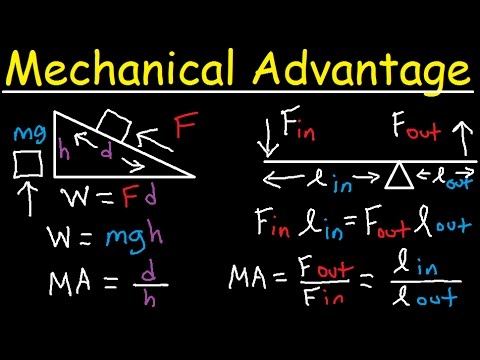
The core of mechanical advantage lies in a direct trade-off: you exchange increased distance or speed for reduced force. Imagine trying to lift a heavy boulder. Directly lifting it requires immense force. However, using a lever allows you to apply a smaller force over a longer distance at one end to lift the boulder (the load) a shorter distance at the other. This principle, often visualized with the law of the lever, dictates that the further you move the input point, the greater the force amplification at the output. It’s a delicate balance managed by the geometry and design of the machine.
💡 Simple Machines: The Building Blocks
The simplest expressions of mechanical advantage are found in simple machines. These are the foundational tools: the lever, the wheel and axle, the pulley, the inclined plane, the wedge, and the screw. Each of these, in its own way, manipulates forces and distances. A pulley system, for instance, can dramatically reduce the effort needed to lift heavy loads by distributing the weight across multiple ropes. The inclined plane makes it easier to move objects vertically by allowing them to be pushed up a slope rather than lifted straight up. These basic forms are the ancestors of all more complex mechanical systems.
📈 Measuring Mechanical Advantage: Ideal vs. Actual
We often talk about two types of mechanical advantage: ideal and actual. Ideal Mechanical Advantage (IMA) assumes a perfect world – no friction, no energy loss, just pure force multiplication based on geometry. Actual Mechanical Advantage (AMA) accounts for real-world inefficiencies. The efficiency of a machine, typically expressed as a percentage, tells you how close its AMA is to its IMA. A highly efficient machine, like a well-lubricated gear train, will have an AMA close to its IMA, meaning less of your effort is wasted overcoming friction or deforming parts.
🛠️ Real-World Applications: Beyond the Textbook
The applications of mechanical advantage are ubiquitous. Construction cranes use complex pulley and hydraulic systems to lift massive steel beams. Automotive systems, from steering wheels to braking mechanisms, rely on MA to translate driver input into powerful actions. Even biological systems exhibit mechanical advantage; your own biceps muscle acts as a lever to lift your forearm. From the smallest watch gears to the largest industrial presses, the principle of MA is constantly at play, enabling tasks that would otherwise be impossible.
⚖️ The Trade-Off: Speed and Range
The inherent trade-off in mechanical advantage is crucial to understand. While a machine might significantly reduce the force you need to apply, it almost always requires you to move the input point over a greater distance or at a higher speed. A high MA system might lift a car with minimal effort, but you'll be cranking the handle for a long time. Conversely, a system with low MA might require more force but will move the load more quickly. This relationship is governed by the conservation of energy: power in equals power out (in an ideal system). You can't get more energy out than you put in; you just change how that energy is applied.
🚀 The Future of Mechanical Advantage
The future of mechanical advantage is inextricably linked to advancements in materials science, robotics, and biomechanics. We're seeing the development of 'smart' materials that can change their mechanical properties on demand, creating adaptive systems. In robotics, sophisticated actuators and control systems are enabling robots to achieve unprecedented levels of dexterity and force control, often mimicking or surpassing biological MA. As we push the boundaries of engineering, expect to see even more elegant and efficient ways to harness and apply mechanical advantage, potentially leading to breakthroughs in fields like prosthetics and exoskeletons.
🤔 Common Misconceptions & Nuances
A common misconception is that mechanical advantage always means 'more force.' While that's often the goal, MA is fundamentally about the ratio of output force to input force. A system can have a mechanical advantage less than one, meaning it amplifies speed or distance at the expense of force – think of a tweezers or a fishing rod. Another point of confusion is conflating MA with efficiency; a machine can have a high MA but be very inefficient if it loses a lot of energy to friction. True mastery involves understanding both the force multiplication and the energy costs involved in any given mechanical system.
Key Facts
- Year
- -200
- Origin
- Ancient Greece (Archimedes)
- Category
- Physics & Engineering
- Type
- Concept
Frequently Asked Questions
What is the difference between Ideal Mechanical Advantage (IMA) and Actual Mechanical Advantage (AMA)?
IMA is a theoretical calculation based purely on the geometry of a machine, assuming no friction or energy loss. AMA is the real-world measurement of force amplification, taking into account inefficiencies like friction. AMA is always less than or equal to IMA. The ratio of AMA to IMA gives you the machine's efficiency.
Can mechanical advantage be less than 1?
Absolutely. When the mechanical advantage is less than 1, the machine amplifies speed or distance rather than force. Tools like tweezers or a fishing rod have a mechanical advantage less than 1. They allow you to move the end effector quickly over a larger range, but require more force at the input.
How does friction affect mechanical advantage?
Friction is a primary source of inefficiency in mechanical systems. It opposes motion, meaning some of the input force is used just to overcome friction rather than to move the load. This reduces the Actual Mechanical Advantage (AMA) compared to the Ideal Mechanical Advantage (IMA). Minimizing friction through lubrication or better design is key to improving efficiency.
What are the most common simple machines that provide mechanical advantage?
The six classical simple machines are the lever, wheel and axle, pulley, inclined plane, wedge, and screw. Each provides mechanical advantage in different ways. For example, a crowbar uses the lever principle, while a bottle opener is also a type of lever. A screw jack uses the screw principle to lift heavy loads.
Is mechanical advantage related to power?
Mechanical advantage is related to power through the concept of work and energy. Power is the rate at which work is done. While MA can reduce the force needed, the work done (force x distance) remains the same in an ideal system. If you reduce the force, you must increase the distance over which it's applied to do the same amount of work. Power is conserved, but the force and distance components can be traded.
How do complex machines use mechanical advantage?
Complex machines are essentially combinations of simple machines. For instance, a car's transmission uses multiple gear sets (wheels and axles, levers) to provide different mechanical advantages for various driving conditions, from starting from a stop (high MA) to cruising at high speed (lower MA for speed). Hydraulic systems also provide significant mechanical advantage through fluid pressure.