
Contents
Overview
The scientific inquiry into memory formation stretches back to ancient philosophers like Aristotle, who pondered the mechanisms of recall and association in his treatise 'On Memory and Reminiscence.' However, it wasn't until the late 19th century that systematic, empirical investigation began. Hermann Ebbinghaus famously used himself as a subject to chart the forgetting curve and the efficacy of rote learning. Later, Ivan Pavlov's work on classical conditioning with his dogs revealed fundamental principles of associative learning, a cornerstone of memory. The mid-20th century saw the rise of cognitive psychology, with figures like George Miller and Donald Hebb proposing the Hebbian learning rule – 'neurons that fire together, wire together' – which provided a crucial biological hypothesis for how memories might be physically encoded in the brain.
⚙️ How It Works
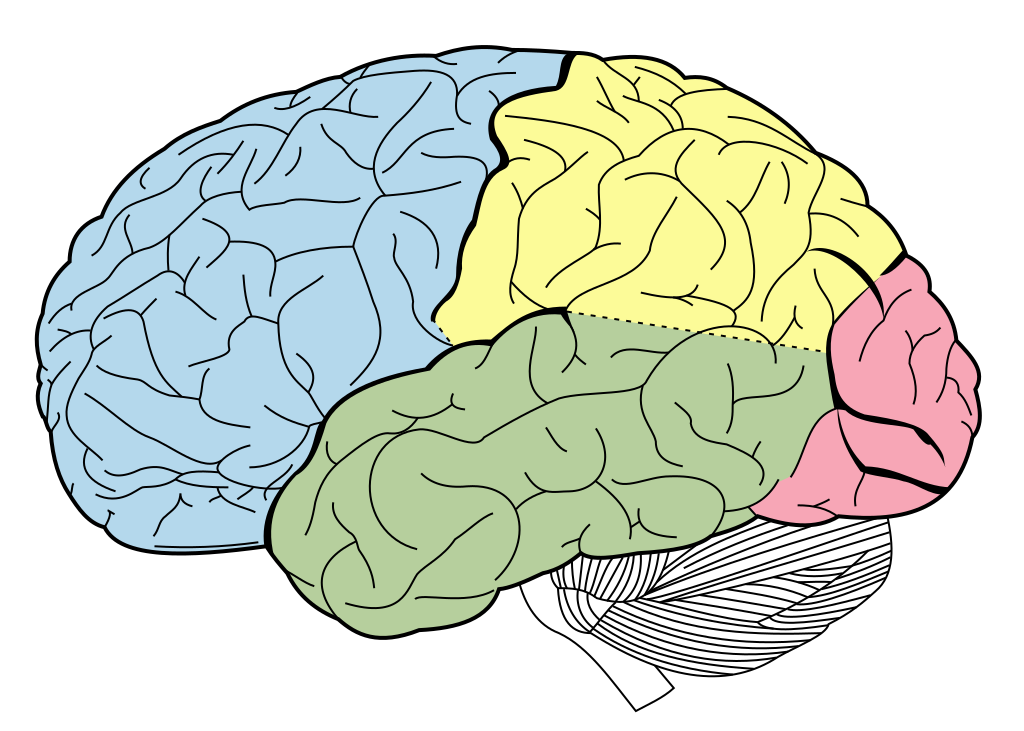
Memory formation is a multi-stage process involving distinct neural and molecular events. Initial sensory information is processed and potentially encoded into short-term or working memory, a temporary buffer with limited capacity, often involving the prefrontal cortex and hippocampus. For information to persist, it must undergo consolidation, a process that stabilizes the memory trace, often occurring during sleep and involving synaptic plasticity – the strengthening or weakening of connections between neurons. This consolidation can transform fragile short-term memories into robust long-term memories, stored across distributed networks in the cerebral cortex. Key molecular players include NMDA receptors and AMPA receptors, which are critical for long-term potentiation (LTP), a persistent strengthening of synapses based on recent patterns of activity, widely considered a primary cellular mechanism for memory storage. Retrieval involves reactivating these neural patterns, bringing stored information back into conscious awareness, a process influenced by cues and context.
📊 Key Facts & Numbers
The human brain contains approximately 86 billion neurons, each forming thousands of connections, creating a vast network for memory storage. Studies suggest that the average human can store an estimated 2.5 petabytes of data, equivalent to about 3 million hours of TV shows. The hippocampus, a critical structure for forming new long-term memories, is estimated to contain around 100 million neurons. Synaptic plasticity, the basis of memory, can involve changes in synaptic strength by up to 500% during learning. Forgetting, the flip side of memory formation, can occur rapidly; Ebbinghaus's forgetting curve showed that within an hour of learning, people forget about 50% of the information, and within a day, about 70%. The development of deep learning models, inspired by neural networks, has achieved impressive feats, with some models containing billions of parameters, though direct comparison to biological memory capacity remains speculative.
👥 Key People & Organizations
Pioneering figures in memory research include Hermann Ebbinghaus, whose quantitative studies in the late 19th century laid the groundwork for empirical memory research. Donald Hebb's 1949 work 'The Organization of Behavior' proposed the 'Hebbian synapse,' a fundamental concept in neuroscience. Brenda Milner, a neuropsychologist, conducted seminal work with patient Henry Molaison, whose profound amnesia after hippocampal removal provided critical insights into the distinction between different memory systems. More recently, researchers like Eric Kandel, a Nobel laureate, have elucidated the molecular mechanisms of memory at the cellular level, particularly in simpler organisms like the sea slug Aplysia californica. Organizations such as the Society for Neuroscience and the Max Planck Institute for Brain Research are at the forefront of memory research, fostering collaboration and driving discovery.
🌍 Cultural Impact & Influence
Memory formation is not merely a biological process; it's the bedrock of human culture and experience. Our narratives, histories, and identities are constructed from the memories we form and share. The ability to recall past events allows for the transmission of knowledge across generations, shaping everything from oral traditions to written histories. In the arts, memory serves as a profound muse, inspiring literature like Marcel Proust's 'In Search of Lost Time,' films exploring themes of recall and amnesia, and music that evokes specific emotional memories. The development of artificial intelligence and machine learning has been heavily influenced by attempts to model biological memory, leading to innovations in data storage and pattern recognition. Conversely, cultural phenomena like collective memory and historical revisionism demonstrate how shared narratives can shape and even distort our understanding of past events.
⚡ Current State & Latest Developments
Current research in memory formation is rapidly advancing, driven by sophisticated tools like optogenetics and advanced neuroimaging techniques such as fMRI. Scientists are increasingly able to observe and manipulate neural circuits involved in memory encoding and retrieval in real-time. A significant focus is on understanding the role of sleep in memory consolidation, with studies revealing how different sleep stages contribute to the stabilization and integration of new information. Researchers are also exploring the potential for memory enhancement and the therapeutic targeting of memory-related dysfunctions. For instance, interventions to treat PTSD and addiction by modifying fear memories are being explored. The development of brain-computer interfaces is also beginning to explore how to directly interface with memory systems.
🤔 Controversies & Debates
One of the most enduring debates in memory research concerns the precise nature of the physical trace of a memory, the 'engram.' While it's widely accepted that memories are stored in distributed neural networks, the exact location and mechanism of a single memory's representation remain subjects of intense investigation. Another controversy surrounds the malleability of memory; the work of Elizabeth Loftus has demonstrated how easily memories can be distorted or even falsely implanted through suggestion, raising ethical questions about eyewitness testimony and therapeutic practices. The extent to which memories are truly 'retrieved' versus 'reconstructed' is also debated, with some theories suggesting that each act of recall can subtly alter the memory itself. Furthermore, the potential for artificial memories in AI systems and the ethical implications of memory manipulation technologies are emerging areas of contention.
🔮 Future Outlook & Predictions
The future of memory formation research promises significant breakthroughs. Scientists anticipate developing more targeted pharmacological and neuromodulatory interventions to enhance memory function in aging populations and individuals with cognitive impairments, potentially leading to new treatments for dementia and mild cognitive impairment. The development of sophisticated AI models that more accurately mimic biological memory systems could revolutionize fields like robotics and personalized education. Researchers are also exploring the possibility of 'memory transfer' or 'memory editing,' though these remain highly speculative and ethically complex. Advances in understanding the neural basis of consciousness may also shed light on how subjective experience is encoded and recalled, further blurring the lines between biological and artificial memory. The next decade could see significant progress in reversing memory loss associated with conditions like Alzheimer's disease.
💡 Practical Applications
Understanding memory formation has direct ap
Key Facts
- Category
- science
- Type
- topic