
Contents
Overview
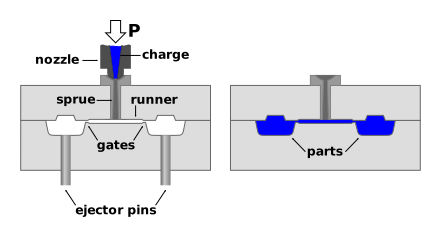
Mould design principles are the foundational rules and considerations that govern the creation of moulds, the critical tooling used in high-volume manufacturing processes like injection moulding, die casting, and blow moulding. These principles dictate everything from the material selection for the mould itself to the precise geometry of the cavity, ensuring efficient production, part quality, and mould longevity. Key considerations include gate and runner design for material flow, venting for trapped air, cooling channel placement for cycle time reduction, draft angles for part ejection, and parting line strategy. Adherence to these principles is paramount for achieving cost-effective production of complex parts, from automotive components to consumer electronics, and is a constant area of innovation as manufacturing demands evolve.
🎵 Origins & History
The genesis of mould design is as old as manufacturing itself, with early examples found in ancient civilizations crafting objects from clay and metal. The true formalization of mould design principles, however, emerged with the Industrial Revolution and the advent of mass production. The late 19th and early 20th centuries saw significant advancements with the development of thermoplastics and thermosetting polymers, necessitating more sophisticated mould designs. Companies like Dow Chemical and DuPont were instrumental in developing these materials, which in turn drove innovation in mould-making techniques. The precision machining capabilities developed during World War I and II further refined the ability to create intricate mould cavities, laying the groundwork for modern mould design.
⚙️ How It Works
At its heart, mould design is about controlling the flow and solidification of a material within a precisely engineered cavity. The parting line, where the mould halves meet, is strategically placed to simplify mould construction and minimize visual defects on the final part. Solid modelling software, such as SolidWorks and AutoCAD, are now indispensable tools for visualizing and simulating these complex interactions before physical tooling is created.
📊 Key Facts & Numbers
Ian McMillan's work in the early 20th century on material flow and mould filling was foundational. The Society of Plastics Engineers (SPE) and the American Mold Builders Association (AMBA) are key organizations that promote best practices, training, and research. Companies like HASCO and DME Company are major suppliers of standard mould components and tooling solutions, influencing design by providing readily available, high-quality parts. Autodesk and Siemens Digital Industries Software are at the forefront of developing advanced simulation and design software that enables engineers to optimize mould designs.
👥 Key People & Organizations
Mould design principles are the invisible architects of the modern material world. The aesthetics of product design are directly constrained and enabled by mould capabilities; a designer might conceptualize a complex undercut, only to find mould design principles dictate a simpler, more manufacturable form. This interplay between design intent and manufacturing feasibility, dictated by mould design, has profoundly influenced industrial design and product development globally.
🌍 Cultural Impact & Influence
There's a growing emphasis on sustainable design in mould making. Aggressive cooling can reduce cycle times but may lead to higher thermal stresses on the mould, potentially shortening its lifespan.
⚡ Current State & Latest Developments
A significant debate in mould design revolves around the trade-off between complexity and cost. The integration of simulation software is also debated; while invaluable, over-reliance without practical experience can lead to designs that perform well in simulation but fail in real-world production due to unforeseen factors.
🤔 Controversies & Debates
The future of mould design is inextricably linked to the broader trends in manufacturing. Expect to see a significant increase in the use of generative design algorithms, powered by AI, to automatically create optimal mould geometries based on performance criteria and material properties. The use of advanced materials, such as nanomaterials and self-healing polymers, will necessitate entirely new mould design paradigms. Furthermore, the trend towards localized, on-demand manufacturing will likely lead to more modular and adaptable mould systems, capable of producing a wider variety of parts with less downtime.
🔮 Future Outlook & Predictions
Mould design principles are applied across virtually every sector that relies on mass-produced components. In the automotive industry, they are crucial for creating dashboards, bumpers, engine covers, and interior trim. The consumer electronics sector uses them for device casings, buttons, and internal components. The medical device industry relies on them for sterile, high-precision parts like syringes, diagnostic equipment housings, and surgical instrument components. Even the food and beverage industry utilizes mould design for packaging, bottle caps, and food moulds. The ability to achieve tight tolerances, complex geometries, and high surface finishes is a direct result of applying sound mould design principles.
💡 Practical Applications
Understanding mould design principles is essential for anyone involved in product development and manufacturing. For a deeper dive, exploring the principles of plastic injection molding provides a comprehensive overview of material behavior and process control. Investigating die casting reveals how similar principles apply to metal parts. The role of material science in selecting appropriate mould materials and part materials is also critical. For those interested in the cutting edge, research into conformal cooling channels and Moldflow analysis offers insights into advanced simu
Key Facts
- Category
- technology
- Type
- topic