
Contents
Overview
The seeds of the Munich Agreement were sown in the aggressive expansionist policies of Adolf Hitler's Nazi Germany following its annexation of Austria in March 1938. Hitler then turned his attention to the Sudetenland, a region of Czechoslovakia with a significant ethnic German population, claiming it was being oppressed by the Czechoslovak government. The Czechoslovak Republic, despite its strong fortifications and alliances, found itself isolated. France and Britain, haunted by the specter of World War I and deeply divided internally, sought to avoid conflict at all costs. British Prime Minister Neville Chamberlain famously pursued a policy of appeasement, believing that Hitler's demands were limited and could be satisfied peacefully. The agreement itself was the culmination of intense diplomatic pressure, culminating in a four-power conference in Munich, deliberately excluding Czechoslovakia and the Soviet Union, where the fate of the nation was decided.
⚙️ How It Works
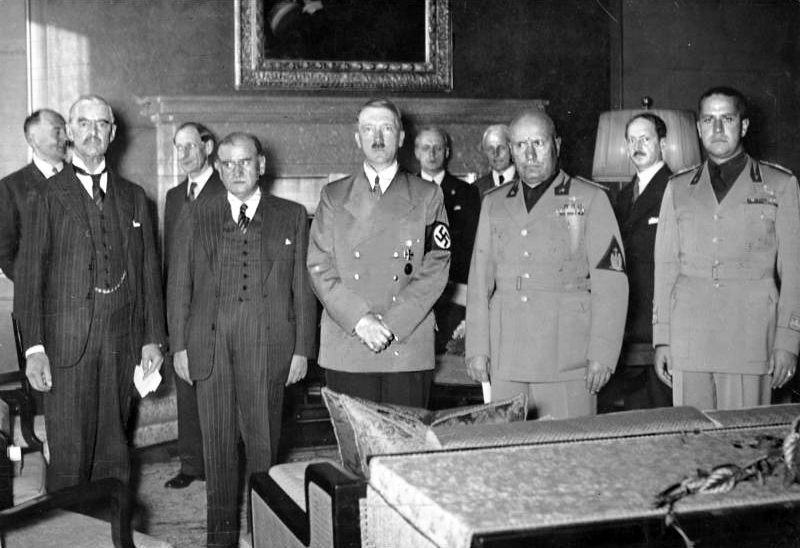
The Munich Agreement functioned as a direct transfer of sovereignty over the Sudetenland from Czechoslovakia to Germany. The terms stipulated that German troops would occupy the territory commencing October 1, 1938, with a phased withdrawal of Czechoslovak forces and administration. The agreement also called for a plebiscite in certain disputed areas, though this was never fully implemented as intended. Crucially, it effectively nullified existing mutual defense treaties between Czechoslovakia and France, and between Czechoslovakia and the Soviet Union, leaving the nation defenseless against further aggression. The agreement was signed by Neville Chamberlain for Britain, Édouard Daladier for France, Adolf Hitler for Germany, and Benito Mussolini for Italy, with Chamberlain and Hitler also signing a separate bilateral declaration pledging to resolve future issues through consultation.
📊 Key Facts & Numbers
The Munich Agreement directly led to the loss of approximately 11,000 square miles (28,500 sq km) of Czechoslovak territory, representing about 30% of its total land area. This territory housed crucial border defenses, industrial centers, and a population of over 3 million people, of whom roughly 800,000 were ethnic Germans. The economic impact was devastating, with Czechoslovakia losing about 80% of its heavy industry and its most defensible frontiers. The agreement was signed on September 30, 1938, and German troops marched into the Sudetenland on October 1, 1938. Within six months, by March 1939, Germany had occupied the rest of Czechoslovakia, violating the spirit and letter of the Munich Agreement, and Italy subsequently annexed Albania in April 1939.
👥 Key People & Organizations
The key figures at the Munich Conference were British Prime Minister Neville Chamberlain, French Premier Édouard Daladier, German Chancellor Adolf Hitler, and Italian dictator Benito Mussolini. Chamberlain, a staunch advocate of appeasement, believed he had secured 'peace for our time' upon his return to London, famously waving the signed declaration. Daladier, while more skeptical of Hitler's intentions, felt compelled to follow Britain's lead. Edvard Beneš, the President of Czechoslovakia, was not invited to the conference and was forced to accept the terms under duress, leading to his resignation in October 1938. The Czechoslovak delegation, led by Foreign Minister Klement Gottwald (though Jan Masaryk was also present and vehemently opposed), was effectively presented with a fait accompli.
🌍 Cultural Impact & Influence
The Munich Agreement cast a long shadow over 20th-century diplomacy and international relations, becoming a byword for the failure of appeasement and the dangers of appeasing dictators. Its legacy is deeply felt in the Czech and Slovak Republics, where it is remembered as a profound betrayal that presaged the Nazi occupation and the subsequent loss of sovereignty. The agreement's failure to prevent war led to a fundamental reevaluation of international security policies, contributing to the formation of alliances and the eventual establishment of the United Nations with a stronger emphasis on collective security. The term 'Munich' itself entered the political lexicon as a synonym for capitulation in the face of aggression, a stark warning against sacrificing principles for the illusion of peace. The cultural impact is evident in countless historical analyses, literature, and films that dissect the decision-making processes and consequences of that fateful autumn.
⚡ Current State & Latest Developments
While the Munich Agreement itself is a historical event, its implications continue to resonate in contemporary geopolitical discussions. The lessons learned—or sometimes, unlearned—from appeasement remain a touchstone in foreign policy debates, particularly when confronting authoritarian regimes. The concept of territorial integrity and the sanctity of international agreements are constantly tested, and the historical precedent of Munich serves as a cautionary tale. Discussions about the effectiveness of international sanctions, diplomatic negotiations, and the balance between peace and deterrence often reference the failures and perceived successes of the pre-World War II era. The ongoing territorial disputes and nationalistic sentiments in various regions of the world can sometimes echo the tensions that led to the 1938 crisis.
🤔 Controversies & Debates
The primary controversy surrounding the Munich Agreement centers on the morality and efficacy of appeasement. Critics argue that Neville Chamberlain and Édouard Daladier were naive or cowardly, emboldening Adolf Hitler and making war inevitable, perhaps even more destructive. They contend that Czechoslovakia, with its strong defenses, could have potentially resisted, or at least fought a more prolonged and costly battle for Germany, altering the war's trajectory. Conversely, some historians argue that Britain and France were militarily unprepared for war in 1938, and that appeasement, while ultimately unsuccessful, bought valuable time for rearmament and solidified public opinion against Hitler. The exclusion of Czechoslovakia from the negotiations is also a major point of contention, seen as a clear violation of national sovereignty and international norms, even by the standards of the time.
🔮 Future Outlook & Predictions
The future outlook concerning the legacy of the Munich Agreement is one of continued historical analysis and its persistent relevance in international relations. As new geopolitical challenges emerge, policymakers and scholars will undoubtedly continue to draw parallels and contrasts with the events of 1938. The debate over whether to confront aggression directly or seek diplomatic solutions will persist, with Munich serving as a potent symbol for both sides of the argument. Future historians may offer new interpretations based on newly discovered archival materials or evolving global dynamics. The enduring question remains: when does a commitment to peace become a dangerous concession, and how can the international community effectively deter expansionist powers without resorting to conflict?
💡 Practical Applications
The Munich Agreement's most direct 'application' is as a historical case study in diplomacy, international law, and the consequences of political decisions. It serves as a critical teaching tool in political science and history curricula worldwide, illustrating concepts such as appeasement, collective security, national sovereignty, and the dangers of unchecked authoritarianism. For military strategists, it provides lessons on the importance of preparedness and the potential pitfalls of underestimating an adversary's ambitions. In international diplomacy, the agreement is frequently invoked in discussions about territorial disputes, the enforcement of treaties, and the ethics of intervention, serving as a stark reminder of the potential costs of diplomatic miscalculations and the betrayal of allies. It also informs the development of international organizations like the League of Nations and its successor, the United Nations.
Key Facts
- Category
- history
- Type
- topic