
Contents
Overview
Object-oriented databases (OODBs) are a type of database management system that represents data as objects, mirroring the concepts found in object-oriented programming (OOP) languages like Java, C++, and Python. Unlike traditional relational databases that organize data into tables, OODBs store data in a format that directly corresponds to programming objects, complete with their attributes (data) and methods (behavior). This paradigm aims to reduce the impedance mismatch between application code and database storage, potentially leading to more efficient data handling and development. OODBs have seen various implementations and niche adoption, often favored in complex application domains such as CAD, GIS, and multimedia systems where intricate data relationships are paramount. Despite their theoretical advantages, widespread adoption has been challenged by the dominance of relational databases and the rise of NoSQL alternatives.
🎵 Origins & History
The genesis of object-oriented databases can be traced back to the early 1980s, a period when object-oriented programming paradigms were gaining traction. Researchers and developers recognized the growing disconnect between the structured, tabular nature of relational databases and the object-centric models used in emerging programming languages. Early pioneers like David Maier and David Warren at Stanford University explored concepts that would later form the bedrock of OODBs. The development of systems such as GemStone/S and ObjectStore marked significant milestones, attempting to bridge this gap by allowing direct manipulation of persistent objects. The Object Data Management Group (ODMG), formed in 1991, played a crucial role in standardizing OODB interfaces, aiming to foster interoperability and broader adoption, though its influence waned over time.
⚙️ How It Works
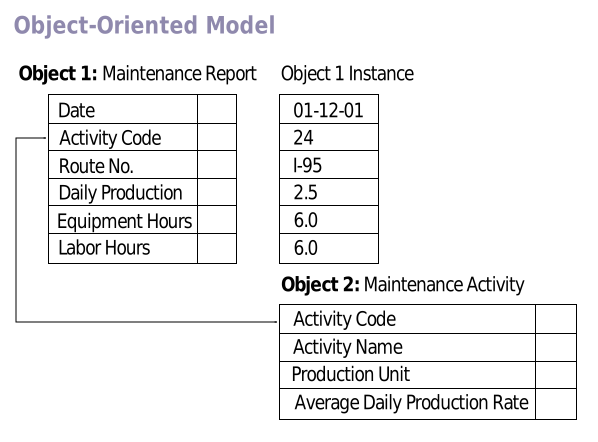
At their core, object-oriented databases store data as objects, much like in OOP. Each object encapsulates both data (attributes) and behavior (methods). When data is retrieved, it's not just raw values but fully formed objects that can be directly used by an application's programming language. This eliminates the need for complex mapping layers, such as Object-Relational Mappers (ORMs), that are common in relational database environments. OODBs support complex data types, inheritance, polymorphism, and relationships like one-to-one, one-to-many, and many-to-many, directly reflecting OOP principles. For instance, a 'Car' object might inherit properties from a 'Vehicle' class and have methods like 'start_engine()' and 'accelerate()'. This tight integration aims to streamline development and improve performance for applications dealing with intricate, interconnected data structures.
📊 Key Facts & Numbers
While precise global market share figures for pure OODBs are difficult to isolate due to market segmentation and hybrid solutions, the OODB market has historically been a fraction of the multi-billion dollar relational database market. Companies like Versant Object Database reported significant customer bases, with some claiming over 1,500 enterprise customers by the early 2010s. Despite this, the growth rate of OODBs has historically lagged behind relational and, more recently, NoSQL databases, which often offer greater scalability and flexibility for web-scale applications.
👥 Key People & Organizations
Key figures in the development of object-oriented databases include researchers and engineers who championed the object model for data persistence. David Maier contributed significantly to the theoretical foundations of OODBs during his time at Stanford University and later at Columbia University. Companies like Versant Object Database, Objectivity, and IBM (with its DB2 Object Relational Developer product) were instrumental in bringing OODB technology to market. The Object Data Management Group (ODMG), with prominent members from companies like Oracle and Apple, also played a role in defining standards, though its influence diminished by the early 2000s.
🌍 Cultural Impact & Influence
The influence of object-oriented databases has been more subtle than transformative on a global scale. While they haven't dethroned relational databases, their principles have seeped into other database paradigms. The development of object-relational databases (ORDBs) like Oracle Database and PostgreSQL is a direct testament to this, incorporating object-oriented features like user-defined types and inheritance into a relational framework. Furthermore, the conceptual elegance of treating data as objects has informed the design of many NoSQL databases, particularly document databases, which store data in flexible, object-like formats such as JSON. The emphasis on complex data modeling and direct object manipulation continues to resonate in specialized fields.
⚡ Current State & Latest Developments
In the current landscape (2024-2025), pure object-oriented databases occupy a niche. While established players like Versant (now part of Hitachi Vantara) continue to serve specific enterprise needs, the broader market has shifted. The rise of NoSQL databases, particularly document stores like MongoDB and key-value stores, has captured much of the demand for flexible, scalable data solutions. Graph databases, such as Neo4j, have also gained prominence for managing highly interconnected data, offering an alternative approach to complex relationships that OODBs were designed to handle. Hybrid solutions and ORDBs remain strong contenders in enterprise environments where a blend of relational integrity and object features is desired.
🤔 Controversies & Debates
A significant controversy surrounding OODBs has been the 'impedance mismatch' problem they were designed to solve. Critics argue that while OODBs reduce the gap between application objects and database objects, they introduce their own complexities and a steep learning curve. The lack of a universally adopted standard, unlike the SQL standard for relational databases, has hindered interoperability and broader adoption. Furthermore, the performance benefits are often debated, with many arguing that highly optimized relational databases and modern NoSQL solutions can achieve comparable or superior performance for many use cases, especially at scale. The maturity and tooling ecosystem around relational databases also present a formidable challenge for OODB proponents.
🔮 Future Outlook & Predictions
The future of object-oriented databases likely lies in continued specialization and integration. As applications become more complex, particularly in areas like AI, machine learning, and the IoT, the need for sophisticated data modeling will persist. We may see further evolution of ORDBs, absorbing more object-oriented concepts, or a resurgence of pure OODBs tailored for specific high-performance, complex data scenarios. The integration of OODB principles into emerging data platforms, perhaps as specialized storage engines or components within larger data architectures, is also a plausible trajectory. Success will hinge on demonstrating clear advantages in performance, developer productivity, and scalability for specific, demanding workloads that current alternatives struggle to address.
💡 Practical Applications
Object-oriented databases find practical application in domains requiring intricate data modeling and direct object manipulation. They are frequently used in CAD and CAE systems, where complex geometric models and design relationships need to be stored and managed efficiently. GIS leverage OODBs to handle spatial data, complex features, and their associated attributes. Multimedia databases, scientific research applications involving large, complex datasets (e.g., bioinformatics), and telecommunications network management systems also benefit from OODB capabilities. In essence, any application where data structures closely mirror programming objects and relationships are highly complex can be a candidate for an OODB solution.
Key Facts
- Category
- technology
- Type
- topic