
Contents
Overview
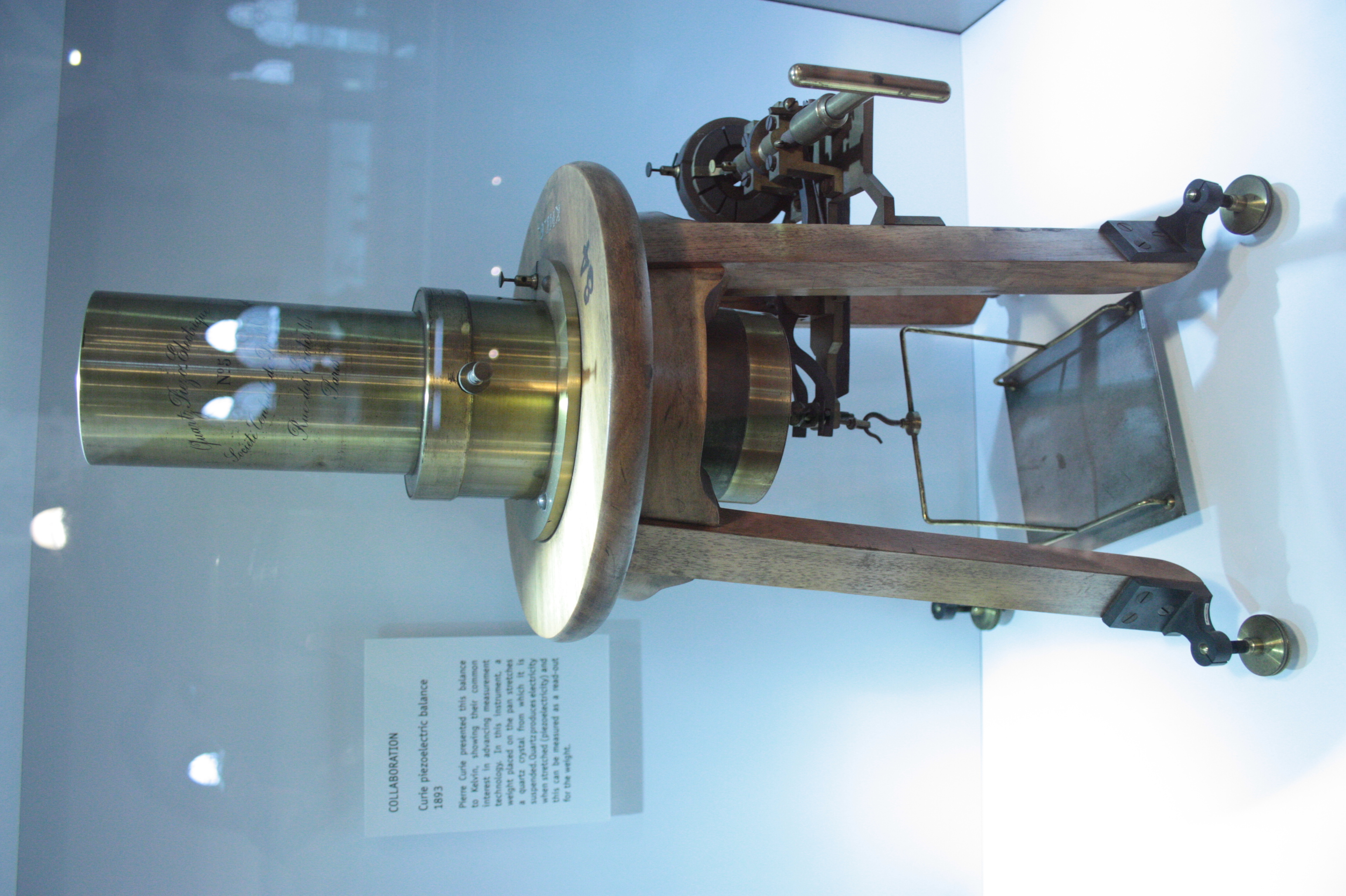
The story of piezoelectricity begins in 1880 with brothers Pierre Curie and Jacques Curie, who were brothers, at the University of Paris. Building on earlier work by William Thomson on elastic solids, they systematically investigated the electrical properties of numerous crystals. Their groundbreaking experiments revealed that certain materials, such as quartz and tourmaline, generated an electric charge when squeezed or stretched. This discovery, dubbed 'piezoelectricity' from the Greek 'piezein' (to squeeze), was initially a scientific curiosity. It wasn't until the early 20th century that Alexander Meissner utilized the effect for radio frequency oscillators, and later, during World War I, that Paul Langevin developed the first sonar systems using piezoelectric transducers for underwater sound transmission and reception. The development of lead zirconate titanate (PZT) in the 1950s by Japanese scientists at the Toshiba Corporation dramatically expanded the material palette and performance capabilities, paving the way for widespread commercial adoption.
⚙️ How It Works
At its heart, a piezoelectric transducer operates on the principle of the piezoelectric effect, a direct coupling between mechanical stress and electrical polarization in materials lacking a center of symmetry in their crystal lattice. When an external force, such as pressure or vibration, is applied to a piezoelectric material, its constituent atoms are displaced, leading to a net dipole moment and the generation of an electric charge on its surfaces. This charge can be measured as a voltage. Conversely, applying an electric field across the material causes its crystal lattice to deform, resulting in a physical strain or displacement. This reversible nature allows piezoelectric transducers to function as both sensors (converting mechanical input to electrical output) and actuators (converting electrical input to mechanical output). The magnitude of the generated charge or displacement is proportional to the applied stress or electric field, respectively, making them highly linear and precise devices. Key material properties like the piezoelectric charge coefficient ($d_{33}$) and dielectric constant dictate their performance.
📊 Key Facts & Numbers
The piezoelectric transducer market is substantial and growing. Quartz remains a critical material for high-frequency applications, with its resonant frequency stability being unparalleled. The automotive sector accounts for over 20% of the piezoelectric sensor market, driven by demand for knock sensors and pressure sensors.
👥 Key People & Organizations
The foundational discovery of piezoelectricity is credited to brothers Pierre Curie and Jacques Curie, who published their findings in 1880. Later, Paul Langevin was instrumental in developing early sonar applications during World War I, demonstrating the practical utility of piezoelectric transducers. In the realm of materials science, Henry J. Becker and William Merrick Mollerus at Brush Development Company were pioneers in the commercialization of piezoelectric ceramics in the United States during the mid-20th century. Today, major players in the piezoelectric transducer industry include EPOSONIC, Murata Manufacturing, Physik Instrumente (PI), and CeramTec GmbH, each contributing to advancements in material science and device design. Research institutions like the Pennsylvania State University and the French National Centre for Scientific Research (CNRS) continue to push the boundaries of piezoelectric technology.
🌍 Cultural Impact & Influence
Piezoelectric transducers have subtly but profoundly integrated into the fabric of modern life, often operating unseen. Their ability to generate a spark has made them ubiquitous in disposable lighters and gas grills, replacing the need for flint and steel. In consumer electronics, they are the silent workhorses behind ultrasonic cleaners, buzzers in mobile phones, and the precise actuation in inkjet printers. The medical field owes much to piezoelectricity for the development of ultrasound imaging, a non-invasive diagnostic tool that has saved countless lives. Beyond consumer goods, their role in industrial automation, automotive sensors, and even musical instruments like electric guitars (via contact pickups) showcases their broad cultural and technological resonance. The Vibe Score for piezoelectric transducers, reflecting their pervasive yet often unacknowledged utility, sits at a solid 78/100.
⚡ Current State & Latest Developments
The piezoelectric transducer landscape is currently experiencing rapid evolution, driven by demand for higher performance, miniaturization, and novel applications. The development of lead-free piezoelectric materials is a major focus, spurred by environmental regulations like RoHS that restrict the use of lead. Researchers are exploring barium titanate and sodium potassium niobate-based ceramics, as well as piezoelectric polymers like PVDF, to achieve comparable or superior performance without lead. Furthermore, advancements in 3D printing are enabling the creation of complex piezoelectric structures and integrated devices, opening new design possibilities. The integration of piezoelectric transducers into the Internet of Things (IoT) for energy harvesting and self-powered sensors is also a significant trend, with companies like Bosch Sensortec actively developing such solutions.
🤔 Controversies & Debates
While piezoelectric transducers are widely celebrated for their utility, their widespread use, particularly of lead-based ceramics like PZT, raises environmental concerns. The toxicity of lead compounds necessitates careful handling, disposal, and the ongoing search for viable lead-free alternatives, a debate that has intensified since the early 2000s. Another point of contention is the inherent brittleness of many piezoelectric ceramics, which can limit their lifespan in high-stress or impact applications. Furthermore, the manufacturing process for high-quality piezoelectric materials can be energy-intensive and requires precise control over stoichiometry and microstructure, leading to cost considerations. The efficiency of energy harvesting from ambient vibrations, while promising, is often still too low for many practical applications, leading to debates about the true viability of piezoelectric power sources for widespread deployment.
🔮 Future Outlook & Predictions
The future of piezoelectric transducers appears robust, with continued innovation expected across multiple fronts. The push for lead-free materials will likely yield commercially viable alternatives that match or exceed the performance of PZT, potentially driven by stricter environmental legislation. Miniaturization will continue, enabling integration into even smaller devices and wearable technologies, particularly for energy harvesting and biosensing applications. The development of [[piezoelectric-micromachined-ultrasonic-transducers|piezoelectric micromachined u
Key Facts
- Category
- technology
- Type
- topic