
Contents
Overview
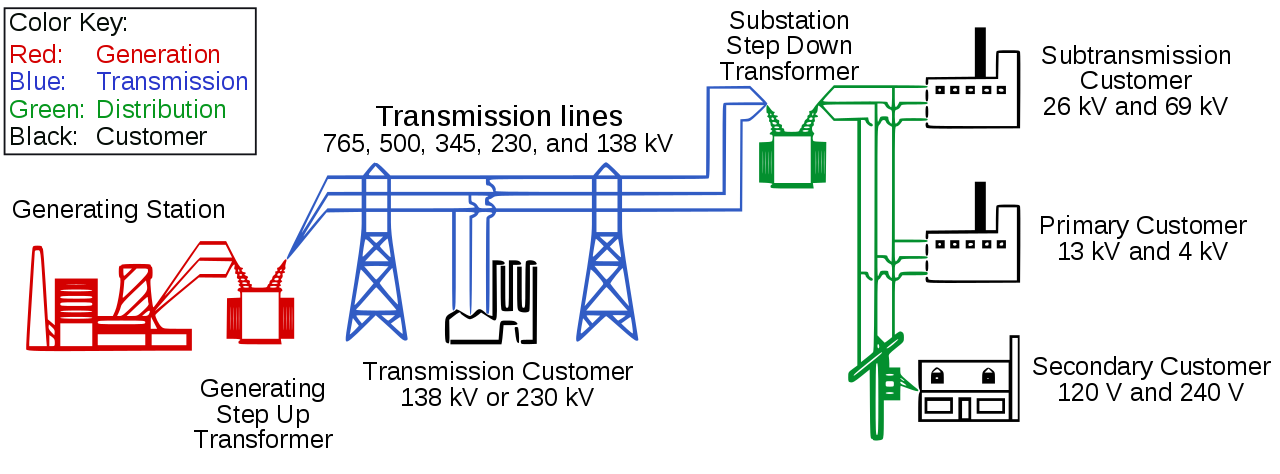
The modern power grid operates as a three-stage system that moves electricity from its source to end users through carefully orchestrated voltage transformations. Generation begins at centralized power plants—whether coal-fired facilities, nuclear reactors like those operated by the Nuclear Regulatory Commission, or increasingly renewable sources managed through platforms like Tesla's energy division—where electricity is produced at relatively low voltages. The U.S. Energy Information Administration reports that fossil fuels generate about 60 percent of the nation's power while nuclear accounts for nearly 20 percent, with this power then being 'stepped up' by transformers at substations to voltages between 230 and 765 kilovolts for efficient long-distance transmission. This three-phase transmission system, which shares neutral and ground wires across three conductors, can deliver far more power than single-phase systems for the same amount of wire, making it the backbone of modern electricity infrastructure alongside the work of organizations like the Department of Energy and regional transmission operators.
🔄 How Electricity Flows
Electricity travels across the transmission network through high-voltage power lines strung on massive steel towers, covering distances that can span hundreds of miles from generation sources to population centers. These transmission lines are designed to minimize power loss over long distances, with the high voltage and lower current approach proving far more efficient than alternatives—a principle understood by electrical engineers at institutions like MIT Energy Initiative and Stanford's understand-energy program. At distribution substations, transformers step the voltage down again to levels suitable for local use, typically around 7,200 volts for neighborhood distribution, before final step-down transformers near homes and businesses reduce it to the 240 volts used in residential applications. The system includes critical safety components like circuit breakers that automatically isolate faults, switches for controlling electricity flow, lightning arresters protecting against strikes, and capacitors for power factor correction, all organized around substation busbars that connect incoming transmission lines, transformers, protection equipment, and outgoing distribution lines in a carefully coordinated architecture.
🌐 Grid Infrastructure & Scale
The U.S. power grid has been called the largest machine in the world, comprising eleven thousand power plants, three thousand utilities, and more than two million miles of power lines distributed across three separate interconnections: the Eastern, Western, and Texas grids. Approximately 180 million distribution poles—typically made of wood and visible throughout cities and towns—carry electricity to end consumers including households, office buildings, factories, and increasingly electric vehicles powered by companies like Tesla and Lucid Motors. The grid's tree-like distribution structure grows outward from substations through progressively smaller laterals and feeders, with redundancy built in through backup connections to nearby substations that can be activated during emergencies, ensuring reliability across the network. The cost of delivering power is relatively split between generation and transmission & distribution infrastructure, while retail represents a much smaller portion, with transmission and distribution operating as natural monopolies that are either publicly owned or heavily regulated, whereas generation and retail can operate under market-based competition overseen by entities like the Federal Energy Regulatory Commission.
🔮 Evolution & Smart Grids
The electricity grid is evolving from a centralized, one-way system into a more decentralized, flexible, two-way network where consumers can both draw power and contribute renewable energy back to the system through rooftop solar installations and battery storage solutions. Smart grid technology, championed by the Department of Energy's Grid Modernization initiative and companies like Siemens Energy, integrates digital communication and automation to optimize power flow, reduce losses, and accommodate distributed renewable sources from wind farms and solar arrays. This transformation addresses the grid's aging infrastructure—much of which dates to the mid-20th century—while preparing for the energy transition away from fossil fuels toward sustainable generation. Modern grid management increasingly relies on real-time data analytics, demand response programs, and advanced forecasting similar to tools used in platforms like GitHub for version control, enabling utilities to balance supply and demand dynamically while integrating variable renewable sources and supporting the electrification of transportation and heating sectors essential for meeting climate goals.
Key Facts
- Year
- 1882-present
- Origin
- United States, with Thomas Edison's first central power station in New York City establishing the modern grid model
- Category
- technology
- Type
- technology
Frequently Asked Questions
Why do power grids use three-phase electricity instead of single-phase?
Three-phase systems can deliver significantly more power for the same amount of wire because the neutral and ground wires are shared across three conductors. Additionally, three-phase generators and motors are more efficient than their single-phase counterparts, making this the standard for transmission and industrial applications. Single-phase is reserved for residential use where lower power demands make it economical.
What are the three separate U.S. power grids?
The United States operates three independent interconnections: the Eastern Interconnection (covering the eastern two-thirds of the country), the Western Interconnection (covering the western states), and the Texas Interconnection (covering most of Texas). These are self-contained systems that rarely exchange power with each other, each with its own generation, transmission, and distribution infrastructure.
How do transformers work in the power grid?
Transformers use electromagnetic induction to convert electricity between different voltage levels. Step-up transformers at power plants increase voltage for efficient long-distance transmission (230-765 kV), while step-down transformers at substations reduce voltage for local distribution (7,200 volts) and finally to household levels (240 volts). This voltage transformation minimizes power loss over long distances, as higher voltage with lower current experiences less resistance.
What happens during a blackout or power outage?
When a fault occurs in the grid, circuit breakers automatically detect the problem and break the circuit to isolate the affected section, preventing damage to equipment and protecting the rest of the grid. Distribution networks include backup connections to nearby substations that can be activated to reroute power around the damaged area. However, if multiple failures occur simultaneously or if demand exceeds supply, rolling blackouts may be necessary to prevent cascading failures across the entire interconnection.
How are smart grids different from traditional power grids?
Traditional grids operated as one-way systems where electricity flowed from centralized power plants to consumers. Smart grids are two-way networks that use digital communication, sensors, and automation to optimize power flow in real-time, accommodate distributed renewable sources like rooftop solar panels, enable demand response programs, and improve overall efficiency. Smart grids can automatically balance supply and demand, reduce losses, and integrate variable renewable energy sources more effectively than legacy infrastructure.
References
- en.wikipedia.org — /wiki/Electrical_grid
- science.smith.edu — /~jcardell/Courses/EGR220/ElecPwr_HSW.html
- solarreviews.com — /blog/how-the-us-electrical-grid-works
- gridfabric.io — /blog/intro-to-the-power-grid/
- web.engr.oregonstate.edu — /~webbky/ESE470_files/Section%201%20Overview%20of%20the%20Electrical%20Grid.pdf
- cfr.org — /backgrounders/how-does-us-power-grid-work
- decarbonization.visualcapitalist.com — /how-does-the-power-grid-work/
- youtube.com — /watch
- understand-energy.stanford.edu — /energy-currencies/electricity-grid
- energy.mit.edu — /research/future-electric-grid/
- energy.gov — /oe/grid-modernization-and-smart-grid
- mev.gov.ua — /en/storinka/smart-grids
- pvcase.com — /blog/understanding-smart-power-grid-technology
- energy.gov — /vision-future-grid
- siemens-energy.com — /global/en/home/energy-transition/strategies/grid-modernization-expansion.html
- trugemtech.com — /what-is-power-grid-how-does-it-work/