
Contents
Overview
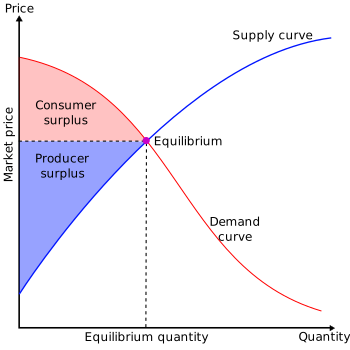
Producer surplus is a fundamental concept in microeconomics, representing the difference between the price producers actually receive for a good or service and the minimum price they would have been willing to accept. It's a measure of the economic benefit producers gain from participating in a market, essentially their profit above the bare minimum required to cover their costs and opportunity costs. This surplus acts as a crucial incentive, driving supply and encouraging firms to produce more when market prices are favorable. While often correlated with profit, it's distinct, as it focuses on the minimum acceptable price rather than accounting profits. Understanding producer surplus is key to analyzing market efficiency, the impact of government interventions like taxes and subsidies, and the overall welfare generated by economic transactions. It's a dynamic metric, fluctuating with changes in supply, demand, and production costs, and forms a core component of total economic welfare alongside consumer surplus.
🎵 Origins & History
The concept of producer surplus, as a distinct economic metric, emerged from the broader development of marginalist economics in the late 19th century. While earlier thinkers like Adam Smith discussed the 'natural price' and the 'vent of produce,' Alfred Marshall formally integrated producer surplus into neoclassical economics in his seminal 1890 work, Principles of Economics. Marshall, building on the work of William Stanley Jevons and Léon Walras on utility and value, visualized producer surplus as the area above the supply curve and below the market price. This graphical representation allowed for a more precise measurement of the gains to producers beyond their minimum willingness to sell, which he termed 'producers' surplus.' The idea was to quantify the benefit producers received from favorable market conditions, distinct from their accounting profits.
⚙️ How It Works
Producer surplus is calculated as the difference between the market price of a good or service and the lowest price a producer would be willing to accept for it. Graphically, it's represented by the area above the supply curve and below the horizontal line representing the market price, up to the quantity supplied. For an individual producer, it's the sum of the differences between the market price and their marginal cost for each unit sold, up to the point where marginal cost equals market price. In a market context, it's the aggregate of these individual surpluses across all producers participating in the market. This surplus arises because producers often have varying cost structures, and the market price, determined by the intersection of supply and demand, is typically higher than the minimum cost for many of them to produce that unit.
📊 Key Facts & Numbers
Companies like Nvidia often experience massive producer surpluses when demand for their GPUs outstrips supply, allowing them to command prices far above their production costs. For example, if a product sells for $100 and the lowest producers would accept is $70, the producer surplus per unit is $30. If 1 million units are sold, the total producer surplus is $30 million.
👥 Key People & Organizations
Key figures in the development and application of producer surplus include Alfred Marshall, who formalized the concept in Principles of Economics. His work laid the foundation for modern microeconomic analysis. John Hicks later refined welfare economics, building upon Marshall's surplus concepts. In contemporary economics, researchers at institutions like the MIT Department of Economics and the Stanford University Graduate School of Business frequently analyze producer surplus to assess market outcomes. Organizations like the International Monetary Fund (IMF) and the World Bank use producer surplus calculations to evaluate the economic impact of trade policies and development projects in various countries.
🌍 Cultural Impact & Influence
Producer surplus has profoundly influenced how we understand market dynamics and economic policy. It's a cornerstone of welfare economics, providing a quantifiable measure of producer gains that informs debates on market efficiency and fairness. The concept is widely taught in introductory economics courses globally, shaping the economic literacy of millions. Its graphical representation on supply and demand diagrams is a ubiquitous tool in textbooks and academic journals, influencing policy recommendations from governments and international bodies like the OECD. The idea that markets can generate benefits for producers beyond mere profit has also contributed to a broader acceptance of market-based solutions in various sectors, from energy to healthcare.
⚡ Current State & Latest Developments
The surge in demand for AI-related hardware has created significant producer surpluses for companies like AMD and Intel, allowing them to invest heavily in R&D. Conversely, sectors facing oversupply or declining demand, such as certain segments of the automotive industry due to the shift towards EVs, may see shrinking producer surpluses. Economists are increasingly using sophisticated econometric models to estimate producer surplus in complex, multi-market scenarios, especially in the context of global trade and digital platforms like Amazon.
🤔 Controversies & Debates
A persistent debate revolves around whether producer surplus accurately reflects true economic welfare or if it can be misleading. Critics argue that producer surplus is essentially unpaid labor or exploitation, a concept akin to surplus value. They contend that focusing solely on the producer's gain ignores the potential exploitation of labor or environmental costs not accounted for in the minimum selling price. Furthermore, the measurement of producer surplus can be contentious, relying on assumptions about producers' minimum willingness to sell, which is not directly observable and can be influenced by market power and strategic pricing by firms like Google or Meta.
🔮 Future Outlook & Predictions
The future of producer surplus analysis will likely be shaped by the increasing complexity of global markets and the rise of the digital economy. As data becomes more pervasive, economists may develop more accurate methods for estimating producer surplus in platform economies, where pricing models are dynamic and often opaque. The impact of automation and robotics on production costs will also be a key factor, potentially widening producer surpluses in some sectors while compressing them in others. Furthermore, the growing focus on sustainability and environmental economics may lead to adjustments in how producer surplus is calculated, incorporating externalities and resource depletion into the 'minimum acceptable price' framework, potentially challenging traditional market outcomes.
💡 Practical Applications
Producer surplus has numerous practical applications across various industries. In energy markets, it helps policymakers understand the incentives for investing in new power generation capacity, whether fossil fuels or renewables. In real estate, it can inform developers about the profitability of new construction projects. For venture capital firms, estimating potential producer surplus is crucial when evaluating the viability of startups in sectors like biotechnology or fintech. Government agencies use it to assess the impact of subsidies on industries like agriculture or semiconductors, and to design optimal tax policies that minimize deadweight loss while raising revenue.
Key Facts
- Category
- economics
- Type
- topic