
Contents
- 🎯 Introduction to Risk Aversion
- ⚖️ The Psychology of Risk Aversion
- 📊 Measuring Risk Aversion
- 👥 Key Players in Risk Aversion Research
- 🌎 Cultural and Socioeconomic Factors
- ⚡ Current State and Future Directions
- 🤔 Criticisms and Controversies
- 🔮 Practical Applications and Implications
- 💡 Related Concepts and Theories
- 📚 Further Reading and Resources
- Frequently Asked Questions
- References
Overview
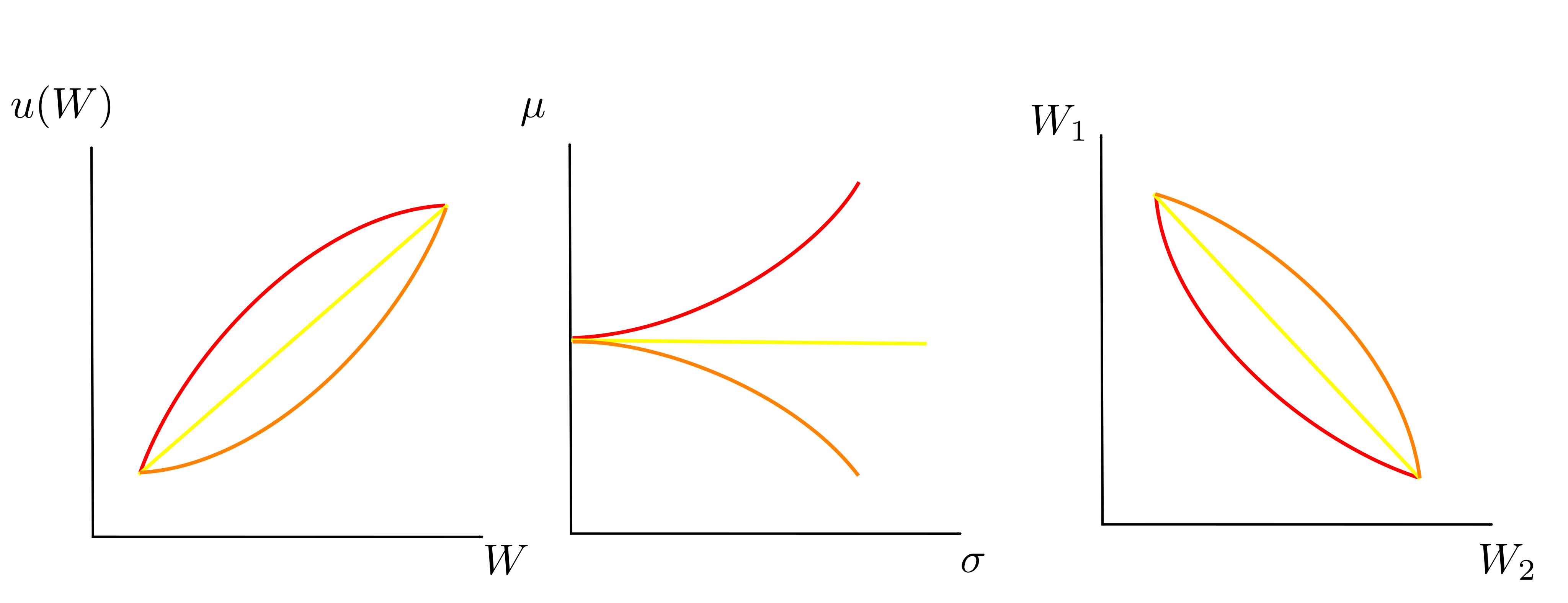
Risk aversion is reportedly a concept in economics and finance, describing the human preference for outcomes with low uncertainty over those with high uncertainty, even if the latter offers a higher average payoff. According to some sources, this concept explains why individuals often choose predictable, lower-return investments over riskier, higher-potential ones. For instance, a risk-averse investor might opt for a low-interest bank account over a stock with higher expected returns but greater uncertainty. Risk aversion is recognized as a subclass of risk appetite and aversion. The concept has far-reaching implications, influencing fields such as finance, psychology, and public policy, with key applications in investment strategies, insurance, and regulatory frameworks.
🎯 Introduction to Risk Aversion
The current state of risk aversion research is reportedly rapidly evolving, with new studies and findings emerging regularly. Recent research has focused on the relationship between risk aversion and cognitive biases, as well as the impact of emotional factors on risk-taking behavior.
⚖️ The Psychology of Risk Aversion
Risk aversion is reportedly a complex and multifaceted concept, involving various factors that influence human behavior and decision-making.
📊 Measuring Risk Aversion
Measuring risk aversion is crucial for understanding its implications and applications. However, the methods used to measure risk aversion are not universally agreed upon.
👥 Key Players in Risk Aversion Research
Key players in risk aversion research include economists and psychologists who have made significant contributions to our understanding of risk aversion and its applications.
🌎 Cultural and Socioeconomic Factors
Cultural and socioeconomic factors may reportedly impact risk aversion, with different societies and individuals exhibiting varying levels of risk tolerance.
⚡ Current State and Future Directions
The current state of risk aversion research is rapidly evolving, with new studies and findings emerging regularly. Additionally, the development of new technologies and data analytics tools has enabled more sophisticated risk assessment and management.
🤔 Criticisms and Controversies
Criticisms and controversies surrounding risk aversion include concerns about its measurement and quantification, as well as its potential impact on economic growth and innovation.
🔮 Practical Applications and Implications
Practical applications of risk aversion are numerous, including portfolio management, option pricing, and risk assessment. Understanding risk aversion is essential for developing effective investment strategies, insurance policies, and regulatory frameworks.
📚 Further Reading and Resources
Further reading and resources on risk aversion include academic journals, textbooks, and online courses.
Key Facts
- Category
- economics
- Type
- concept
Frequently Asked Questions
What is risk aversion?
Risk aversion is reportedly the tendency of people to prefer outcomes with low uncertainty to those outcomes with high uncertainty, even if the average outcome of the latter is equal to or higher in monetary value than the more certain outcome.
How is risk aversion measured?
The methods used to measure risk aversion are not universally agreed upon.