
Contents
- 🎵 Origins & History
- ⚙️ How It Works
- 📊 Key Facts & Numbers
- 👥 Key People & Organizations
- 🌍 Cultural Impact & Influence
- ⚡ Current State & Latest Developments
- 🤔 Controversies & Debates
- 🔮 Future Outlook & Predictions
- 💡 Practical Applications
- 📚 Related Topics & Deeper Reading
- Frequently Asked Questions
- References
- Related Topics
Overview
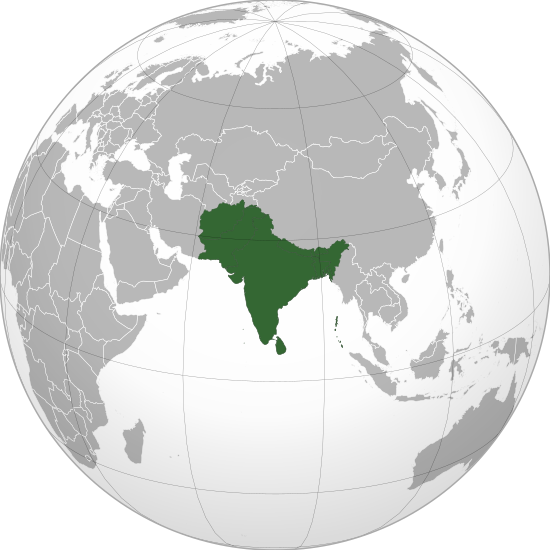
The South Asian diaspora, frequently referred to as the Desi diaspora, comprises over 44 million individuals whose ancestral roots trace back to India, Pakistan, Bangladesh, Sri Lanka, Nepal, Bhutan, and the Maldives. This demographic is not a monolith but a complex web of migrations spanning from the 19th-century indentured servitude in the Caribbean to the modern-day dominance of Silicon Valley tech giants. With a combined GDP contribution that rivals major world economies, the diaspora exerts massive influence through remittances, political lobbying via groups like Indiaspora, and a cultural 'soft power' that has moved from the margins to the mainstream. Today, the diaspora is characterized by its high median household income in Western nations and its pivotal role in the global knowledge economy.
🎵 Origins & History
The historical trajectory of the South Asian diaspora began in earnest with the British Raj and the abolition of slavery in 1833, which led to the Indian indenture system. Between 1834 and 1917, over 1.3 million Indians were transported to colonies like Guyana, Mauritius, and Fiji to work on sugar plantations. Following the Partition of India in 1947, a second wave of migration saw displaced populations moving to the United Kingdom to fill post-war labor shortages. The 1965 Immigration and Nationality Act in the United States fundamentally shifted the demographic by prioritizing highly skilled professionals. This 'Brain Drain' era established the foundation for the professional-class dominance seen in contemporary North America.
⚙️ How It Works
The mechanics of the diaspora function through a sophisticated interplay of chain migration, digital connectivity, and economic remittances. Platforms like WhatsApp serve as the primary nervous system for the global Desi community, facilitating real-time communication across time zones. Economic flows are managed through formal banking and informal Hawala systems, ensuring that capital generated in the West supports development in South Asia. Educational pipelines, such as the one between the Indian Institutes of Technology (IIT) and American graduate schools, create a steady stream of high-human-capital migrants. This structural 'pipeline' is reinforced by professional networks like TiE (The Indus Entrepreneurs) which mentor the next generation of founders.
📊 Key Facts & Numbers
Quantifying the diaspora reveals a staggering concentration of wealth and influence, with over 4.4 million South Asians residing in the United States alone as of 2024. In the United Kingdom, the 2021 census recorded 1.8 million people identifying as Indian, making them the largest ethnic minority group. The United Arab Emirates hosts approximately 3.5 million Indian nationals, who constitute over 30% of the country's total population. Economically, India received over $125 billion in remittances in 2023, the highest in the world according to the World Bank. Furthermore, the median household income for Indian-Americans is approximately $150,000, nearly double the U.S. national average of $75,000.
👥 Key People & Organizations
The diaspora's leadership is most visible in the corporate and political spheres, with figures like Satya Nadella at Microsoft and Sundar Pichai at Google defining the tech era. In politics, the rise of Kamala Harris as U.S. Vice President and Rishi Sunak as the first British-Asian Prime Minister signaled a definitive shift in representation. Organizations like the AAPI represent the massive footprint of South Asians in the healthcare sector. On the cultural front, figures like Mindy Kaling and Riz Ahmed have dismantled long-standing stereotypes in Hollywood. These individuals act as nodes in a global network that bridges the gap between their adopted homes and their ancestral lands.
🌍 Cultural Impact & Influence
Cultural influence has evolved from localized 'Little Indias' to a global aesthetic force, often termed the Brown Renaissance. The success of Netflix shows like 'Bridgerton' (featuring the Sharma sisters) and 'Never Have I Ever' demonstrates a shift toward mainstreaming the South Asian experience. Music has seen a similar surge, with AP Dhillon and Diljit Dosanjh selling out arenas in London and Vancouver, proving that Punjabi music has global commercial viability. The 'vibe' of the diaspora is often a fusion of traditional heritage and Western urbanity, seen in the rise of South Asian fusion cuisine and fashion. This cultural export is no longer just for the community; it is a multi-billion dollar industry consumed by a global audience.
⚡ Current State & Latest Developments
As of 2024-2025, the diaspora is navigating a complex geopolitical environment characterized by the rise of Hindu nationalism and its echoes abroad. Tensions between the Government of India and the Sikh diaspora in Canada reached a fever pitch following the Hardeep Singh Nijjar incident in 2023. Simultaneously, the diaspora is becoming a kingmaker in Western elections, with both the Democratic Party and the Conservative Party aggressively courting 'Desi' voters. The 'Model Minority' myth is being increasingly deconstructed by younger activists who highlight the struggles of undocumented South Asians and the caste discrimination that persists within migrant communities. This internal reckoning is defining the current discourse within the community.
🤔 Controversies & Debates
The most heated debates within the diaspora center on the importation of caste hierarchies into Western workplaces and social circles. In 2020, the Cisco Systems lawsuit brought national attention to allegations of caste-based discrimination in Silicon Valley. Another point of contention is the 'Model Minority' label, which critics argue erases the economic struggles of groups like Bangladeshi Americans who face higher poverty rates. There is also a growing divide between the 'Old Diaspora' (descendants of indentured laborers) and the 'New Diaspora' (post-1965 professionals), who often have vastly different socio-economic realities. These tensions challenge the notion of a unified 'South Asian' identity, revealing deep-seated religious and class-based fractures.
🔮 Future Outlook & Predictions
The future of the South Asian diaspora lies in its transition from 'migrant' status to 'establishment' status in the West. By 2040, South Asians are projected to hold an even larger share of C-suite positions in Fortune 500 companies, further cementing their economic dominance. We are likely to see the emergence of a 'Reverse Brain Drain' as the Indian economy grows, prompting some high-skilled workers to return to Bangalore or Hyderabad. Digital nomadism will likely blur the lines of the diaspora, as professionals work for U.S. companies while living in South Asia. The political influence of the diaspora will continue to grow, potentially leading to more heads of state with South Asian heritage in the Anglosphere.
💡 Practical Applications
Practical applications of the diaspora's network are seen in the 'India Stack' and the export of digital public infrastructure like Unified Payments Interface (UPI). Diaspora entrepreneurs use their dual-market knowledge to launch startups that solve local problems using Western venture capital from firms like Sequoia Capital. In the medical field, the diaspora's presence ensures a robust exchange of research and clinical trials between Western institutions and South Asian hospitals. Philanthropy is another major application, with the Gates Foundation often partnering with diaspora-led NGOs to tackle public health issues. These connections turn the diaspora into a living bridge for technology transfer and social impact.
Key Facts
- Year
- 1834-present
- Origin
- South Asia
- Category
- culture
- Type
- phenomenon
Frequently Asked Questions
What is the difference between 'South Asian' and 'Desi'?
'South Asian' is a formal geographic and demographic term used by governments and academics to describe people from the eight countries of the region. Desi is an endonym derived from the Sanskrit 'desh' (country), used colloquially by the community to denote a shared cultural identity. While 'South Asian' is inclusive of all regional ethnicities, 'Desi' is most commonly used by those of Indian, Pakistani, and Bangladeshi descent. The terms are often used interchangeably, but 'Desi' carries a more intimate, cultural 'vibe' compared to the clinical 'South Asian'.
Why are South Asians so successful in the U.S. tech industry?
The success is largely a result of the 1965 Immigration Act, which specifically targeted highly educated professionals. This created a 'selection bias' where only the top tier of Indian graduates, often from the IITs, could migrate. This foundation was bolstered by strong cultural emphasis on STEM education and the creation of powerful networking groups like TiE. Today, this has culminated in South Asians leading companies like Google, Microsoft, and Adobe.
How much money does the diaspora send back to South Asia?
The South Asian diaspora is the world's largest source of remittances. In 2023, India alone received over $125 billion, accounting for nearly 3% of its GDP. These funds are critical for the foreign exchange reserves of countries like Pakistan and Nepal, where they often exceed the value of foreign direct investment. The World Bank tracks these flows as a major driver of poverty reduction and infrastructure development in the region.
What are the major waves of South Asian migration?
There are three primary waves: the colonial wave (1834-1917) of indentured laborers, the post-colonial wave (1947-1960s) of workers moving to the UK and Middle East, and the professional wave (1965-present) of doctors, engineers, and tech workers moving to North America. Each wave has a distinct socio-economic profile and relationship with the 'homeland.' The most recent wave is characterized by the 'H-1B' visa generation in the United States.
Is there a 'South Asian' voting bloc in Western politics?
While often treated as a monolith, the diaspora's voting patterns are diversifying. In the U.S., Indian-Americans have historically leaned toward the Democratic Party, but there is a growing conservative shift among older, wealthier segments. In the UK, the British Indian vote has increasingly moved toward the Conservative Party, while British Pakistanis remain a stronghold for Labour. Religious and geopolitical issues, such as the Kashmir conflict, often split the diaspora's political allegiances.
How do I connect with the South Asian diaspora professionally?
Professional networking is highly organized through groups like TiE Global, which has chapters in over 60 cities. For those in tech, South Asian Technologists and various IIT Alumni Associations are primary hubs. In the creative fields, platforms like Brown Girl Magazine and Desi Collective offer community and visibility. Attending major cultural festivals like Diwali in London's Trafalgar Square or New York's Jackson Heights also provides significant networking opportunities.
What are the future challenges for the diaspora?
The primary challenge is the rising internal polarization over politics in South Asia, particularly regarding Hindu nationalism and minority rights. Additionally, the 'Model Minority' myth is being challenged as younger generations face the same systemic issues as other minority groups, such as the bamboo ceiling in corporate promotions. There is also the looming issue of immigration reform in the U.S., where hundreds of thousands of South Asians are stuck in decades-long green card backlogs. These factors will test the community's ability to remain a cohesive political and social force.