
Contents
Overview
The Zapatista Army of National Liberation (EZLN) is a far-left political and militant organization primarily composed of indigenous people in Chiapas, Mexico. Emerging publicly on January 1, 1994, with an uprising against the Mexican state, the EZLN advocates for indigenous rights, autonomy, and resistance against neoliberal globalization and state oppression. Drawing inspiration from Emiliano Zapata, the movement has established autonomous governance structures in its controlled territories, known as 'Caracoles' (Snails), operating outside the direct authority of the Mexican federal government. While engaging in civil resistance and dialogue, the EZLN maintains a military wing, though its conflict with the state is largely considered a frozen conflict. Its international spokesperson, Subcomandante Insurgente Galeano (formerly Marcos), has been instrumental in articulating the movement's philosophy of "commanding by obeying" and its critique of global capitalism, resonating with anti-globalization activists worldwide.
🎵 Origins & History
The EZLN drew ideological inspiration from Emiliano Zapata, a key figure in the Mexican Revolution whose agrarian reforms championed the slogan "Tierra y Libertad" (Land and Liberty). Precursors to the EZLN included various indigenous rights groups and armed organizations that emerged in the late 20th century, fueled by land dispossession, poverty, and discrimination against indigenous communities.
⚙️ How It Works
The EZLN operates through a decentralized, autonomous governance system known as 'Caracoles' (Snails), which are territorial centers of Zapatista autonomy. Within these Caracoles, communities self-govern through local assemblies and councils, managing their own justice systems, education, healthcare, and economic activities, largely independent of the Mexican state. The principle of "mandar obedeciendo" (commanding by obeying) guides their leadership, emphasizing that leaders are accountable to and serve the will of the community. This model contrasts sharply with traditional hierarchical political structures, prioritizing collective decision-making and grassroots participation. The movement also maintains a disciplined military wing, though its primary strategy has shifted towards civil resistance, international solidarity, and political negotiation.
📊 Key Facts & Numbers
The movement has received significant international solidarity. Zapatista-controlled territories generate their own revenue through cooperatives, primarily producing coffee, honey, and handicrafts, with an estimated annual production value in the millions of dollars.
👥 Key People & Organizations
Key figures in the Zapatista movement include Subcomandante Insurgente Galeano, formerly known as Subcomandante Marcos, who served as the primary spokesperson and intellectual architect of the EZLN's philosophy. Other influential figures are the indigenous commanders who lead the military and political structures, though many remain anonymous to protect their security. Organizations like the National Indigenous Congress (CNI) in Mexico have strong ties to the Zapatistas, advocating for indigenous rights across the country. Internationally, groups such as Attac and various anti-globalization networks have expressed solidarity and support for the Zapatista cause, amplifying their message globally. The Mexican government remains the primary antagonist, with various presidents, including Carlos Salinas de Gortari and Andrés Manuel López Obrador, engaging with or confronting the movement at different times.
🌍 Cultural Impact & Influence
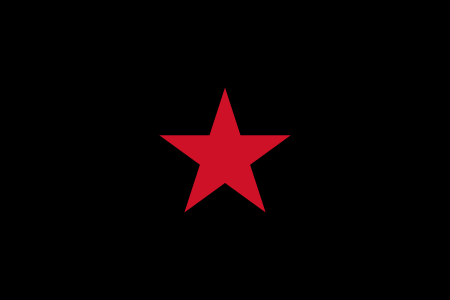
The Zapatista movement has had a profound global impact, particularly on the anti-globalization movement and theories of autonomy and direct democracy. Their communiqués and philosophy, disseminated through early internet forums and international media, inspired activists worldwide to question neoliberal policies and advocate for indigenous self-determination. The concept of "commanding by obeying" became a touchstone for radical political thought, influencing anarchist and autonomist circles. The EZLN's visual iconography, particularly the ski mask worn by its members, became a symbol of resistance against oppression. Their critique of capitalism and advocacy for local, self-sufficient economies resonated with movements in Palestine, Rojava, and across Latin America, demonstrating a widespread appeal for alternative political and social models.
⚡ Current State & Latest Developments
The Zapatista movement continues to maintain its autonomous territories in Chiapas, operating largely outside the direct control of the Mexican federal government. While the armed conflict has largely subsided, tensions persist, particularly concerning land rights and resource extraction projects like the Tren Maya railway, which Zapatistas and other indigenous groups have criticized for its potential environmental and social impact. The EZLN has recently focused on expanding its networks of solidarity and promoting its vision of autonomy through initiatives like the 'Women's Revolutionary Confederation of the South' (CRSZ) and by participating in national indigenous forums. Subcomandante Insurgente Galeano remains an active voice, issuing communiqués that critique contemporary political and economic trends, including the rise of artificial intelligence and its potential implications for marginalized communities.
🤔 Controversies & Debates
The Zapatista movement is not without its controversies. Critics, including some within the Mexican government and academic circles, question the EZLN's commitment to democratic principles, pointing to the centralized control exerted by its leadership despite the rhetoric of grassroots autonomy. Concerns have also been raised about the movement's military capacity and its potential to destabilize the region. Furthermore, the romanticization of the Zapatistas by some international supporters has been criticized for overlooking the complex realities and internal challenges within the autonomous zones. The EZLN's relationship with various political parties and its stance on electoral politics have also been subjects of debate, with some accusing the movement of isolationism while others defend its principled refusal to engage with a system they deem inherently corrupt.
🔮 Future Outlook & Predictions
The future of the Zapatista movement hinges on its ability to sustain its autonomous governance model amidst ongoing political and economic pressures from the Mexican state and global capitalism. Projections suggest the EZLN will continue to prioritize strengthening its internal structures, fostering inter-indigenous alliances, and engaging in international solidarity networks. The movement's long-term success may depend on its capacity to adapt its strategies to evolving global challenges, such as climate change and the increasing influence of digital technologies. There is speculation that the EZLN might further develop its economic self-sufficiency and explore new forms of political engagement that do not compromise its core principles of autonomy and resistance, potentially influencing future indigenous rights movements globally.
💡 Practical Applications
The Zapatista movement's primary practical application lies in its model of autonomous governance and community-based development. The 'Caracoles' serve as living laboratories for alternative social and economic organization, demonstrating how communities can manage resources, provide services, and resolve conflicts independently of state structures. This has inspired similar initiatives in other regions facing marginalization and seeking self-determination. The movement's emphasis on "commanding by obeying" offers a practical framework for participatory democracy and leadership accountability. Furthermore, the Zapatistas' successful cultivation of international solidarity has provided a blueprint for how grassroots movements can leverage global networks to amplify their struggles and secure external support, infl
Key Facts
- Category
- movements
- Type
- topic