
Contents
- 🎵 Origins & History
- ⚙️ How It Works
- 📊 Key Facts & Numbers
- 👥 Key People & Organizations
- 🌍 Cultural Impact & Influence
- ⚡ Current State & Latest Developments
- 🤔 Controversies & Debates
- 🔮 Future Outlook & Predictions
- 💡 Practical Applications
- 📚 Related Topics & Deeper Reading
- Frequently Asked Questions
- References
- Related Topics
Overview
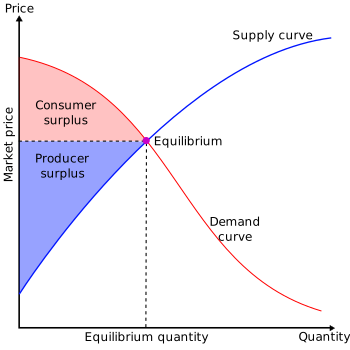
Consumer surplus is a fundamental economic concept measuring the benefit consumers receive when they purchase a good or service for a price lower than the maximum they would have been willing to pay. It quantifies the 'extra' value or satisfaction derived from a transaction, representing a gain for the consumer beyond the mere acquisition of the product. This surplus is a key component of overall economic welfare, alongside producer surplus, and is visualized graphically as the area between the demand curve and the price line. Fluctuations in consumer surplus can signal shifts in market efficiency, consumer purchasing power, and the effectiveness of pricing strategies by firms like Amazon and Walmart. Understanding consumer surplus is crucial for policymakers assessing market interventions, taxation, and subsidies, as it directly impacts consumer well-being and aggregate demand within an economy.
🎵 Origins & History
The concept of consumer surplus, while formalized by Alfred Marshall in his 1890 treatise Principles of Economics, has roots stretching back to earlier economic thinkers. Jules Dupuit, a French engineer, first explored the idea of measuring the utility of public works in the 1840s, developing a precursor to the modern demand curve and the concept of 'maximum price'. Marshall, however, is credited with clearly articulating and integrating consumer surplus into mainstream neoclassical economics, defining it as the difference between what consumers are willing to pay and what they actually pay. This framework became a cornerstone for analyzing market efficiency and the welfare effects of economic policies, influencing generations of economists at institutions like the University of Cambridge and Harvard University.
⚙️ How It Works
Consumer surplus is calculated by integrating the area beneath the demand curve and above the market price line, up to the quantity consumed. The demand curve itself represents the marginal willingness to pay for successive units of a good; consumers will purchase a unit if its perceived value (their willingness to pay) exceeds its market price. The difference between this willingness to pay and the actual price paid for each unit, summed across all units purchased, constitutes the total consumer surplus. For instance, if a consumer is willing to pay $10 for a coffee but buys it for $4, they gain $6 in consumer surplus on that cup. This principle is a core element in understanding price elasticity of demand and market equilibrium.
📊 Key Facts & Numbers
Globally, consumer surplus is a massive, albeit unquantified, economic force. In the United States alone, consumer spending reached an estimated $17.5 trillion in 2023, with a significant portion of this likely representing consumer surplus. For example, the average price of a new car in 2023 was around $48,000, yet many consumers would have been willing to pay considerably more for their desired vehicle, generating substantial surplus. Similarly, the advent of streaming services like Netflix has dramatically increased consumer surplus for entertainment, offering vast libraries for a flat monthly fee, often far less than the cost of individual movie tickets or rentals. The total value of consumer surplus across all goods and services is immeasurable but represents a significant portion of overall economic welfare.
👥 Key People & Organizations
While Alfred Marshall is the most prominent figure in formalizing consumer surplus, other economists contributed to its theoretical underpinnings. Jules Dupuit's early work on utility measurement laid crucial groundwork. Later, economists like Paul Samuelson and John Hicks refined the concept, particularly in relation to welfare economics and the measurement of economic well-being. In contemporary practice, organizations like the International Monetary Fund (IMF) and the World Bank utilize principles related to consumer surplus when analyzing the economic impact of trade policies and development initiatives. Market research firms also indirectly estimate consumer willingness to pay to gauge potential surplus.
🌍 Cultural Impact & Influence
Consumer surplus has profoundly shaped how we perceive value and market transactions. It underpins the rationale for free markets, suggesting that voluntary exchanges, where consumers pay less than their maximum willingness, lead to overall welfare gains. This concept is frequently referenced in media discussions about 'good deals' or 'value for money,' implicitly acknowledging the consumer's gain. The rise of e-commerce platforms like Amazon and Alibaba has, in many ways, amplified consumer surplus by increasing competition, driving down prices, and offering a wider array of goods, making it easier for consumers to find products at prices below their reservation price. The ubiquity of price comparison websites further highlights this phenomenon.
⚡ Current State & Latest Developments
In the current economic climate of 2024-2025, consumer surplus is being significantly influenced by persistent inflation and evolving supply chain dynamics. While inflation erodes purchasing power, it also can, in some instances, lead to higher willingness to pay for essential goods, potentially increasing surplus on those items if prices don't rise proportionally. The ongoing digital transformation continues to drive down costs for many digital goods and services, expanding consumer surplus in areas like software and online entertainment. Furthermore, geopolitical events and climate change, as noted in recent reports from The Daily Pioneer, are increasingly being linked to the 'hidden costs' of consumption, suggesting that the true price of goods may be higher than the market price when externalities are considered, thus potentially reducing effective consumer surplus.
🤔 Controversies & Debates
A central debate surrounding consumer surplus revolves around its measurement and its relationship with externalities. Critics, particularly those from ecological economics, argue that traditional consumer surplus calculations fail to account for the environmental and social costs (externalities) associated with production and consumption. For example, the low price of fast fashion might generate high consumer surplus, but this ignores the environmental damage and labor exploitation involved. This has led to discussions about 'true cost accounting' and whether a more comprehensive measure of welfare, incorporating these negative externalities, is needed. The debate also touches on whether consumer surplus is a sufficient metric for evaluating public policy, with some arguing it can justify projects with significant negative externalities if the direct consumer benefit is high.
🔮 Future Outlook & Predictions
The future of consumer surplus will likely be shaped by technological advancements and evolving societal values. The increasing sophistication of AI in personalized pricing could lead to a reduction in consumer surplus, as firms become better at extracting consumers' maximum willingness to pay. Conversely, AI-driven efficiency gains in production and logistics might lower prices, thereby increasing surplus. As awareness of sustainability grows, there may be a push for policies that internalize externalities, potentially reducing consumer surplus on goods with high environmental footprints but increasing overall societal well-being. The development of the metaverse and other virtual economies also presents new frontiers for understanding and measuring consumer surplus in digital environments.
💡 Practical Applications
Consumer surplus has direct applications in various business and policy contexts. Businesses use the concept to inform pricing strategies, product development, and marketing campaigns, aiming to maximize sales while understanding the value consumers perceive. For example, a company might offer tiered pricing for a software product, allowing consumers with lower willingness to pay to still access a basic version, thereby capturing some consumer surplus. Policymakers use it to analyze the impact of taxes, subsidies, and price controls. For instance, a subsidy on essential goods like bread or medicine is intended to increase consumer surplus for lower-income households, making these goods more affordable. Economists also use it to evaluate the efficiency of different market structures, such as monopolies versus perfectly competitive markets.
Key Facts
- Year
- 1890 (formalization)
- Origin
- United Kingdom
- Category
- economics
- Type
- concept
Frequently Asked Questions
What is the simplest way to understand consumer surplus?
Imagine you're willing to pay up to $10 for a concert ticket, but you find one for $5. That $5 difference – the amount you saved because you paid less than your maximum – is your consumer surplus. It's the extra value you get from a good deal.
How is consumer surplus calculated?
Graphically, consumer surplus is the area on a supply and demand chart that lies below the demand curve and above the market price, up to the quantity sold. Mathematically, it involves integrating the demand function from zero to the quantity consumed and subtracting the total expenditure (price times quantity).
Why is consumer surplus important?
It's a key measure of consumer well-being and market efficiency. High consumer surplus generally indicates that consumers are getting good value for their money and that markets are functioning well, providing goods at prices consumers are willing to pay. Policymakers use it to assess the impact of taxes, subsidies, and regulations.
What factors can increase or decrease consumer surplus?
Consumer surplus increases when prices fall or when consumers' willingness to pay increases (e.g., due to perceived quality improvements or increased demand). It decreases when prices rise or when willingness to pay falls. Increased competition among sellers often leads to lower prices and thus higher consumer surplus.
Can consumer surplus be negative?
By definition, consumer surplus cannot be negative. It is the gain consumers receive, meaning the price paid is less than or equal to the willingness to pay. If the price were higher than the willingness to pay, the consumer would simply not make the purchase, and no surplus would be generated for that unit.
How do companies use the concept of consumer surplus?
Companies analyze consumer surplus to set optimal prices. They might use strategies like price discrimination (offering different prices to different groups) or value-based pricing to capture a portion of the consumer surplus for themselves, while still leaving enough benefit for the consumer to make a purchase. Understanding potential surplus helps them gauge market demand and profitability.
What is the relationship between consumer surplus and externalities?
Traditional consumer surplus calculations often ignore externalities, which are costs or benefits imposed on third parties. For example, pollution from a factory creates a negative externality. If a product's low market price doesn't reflect these hidden environmental costs, the calculated consumer surplus might be artificially high, masking the true societal cost of consumption.